R. Scott Bakker wrote on his blog that he is now in the polishing stage of a fully written The White-Luck Warrior. He has also changed the title of the third Aspect Emperor novel to The Unholy Consult (previously The Horns of Golgoterath). Last but not least, he announced that the recently released White-Luck cover is only a stand-in for the ARCs, and will, hopefully, be replaced with something that doesn't look like - to quote Bakker - a POV shot of his childhood.
Meanwhile, the author expressed his optimism that he will reach the end of the journey that The Second Apocalypse has turned out to be. Bakker also seems sure now that the third and last series in the cycle is going to be a duology.
Man, I can't wait for The White-Luck Warrior to be released!
Jul 8, 2010


Official statement from Night Shade Books
I you are following the blogosphere, you've probably read Liz Williams' and Brendan Halpin's statements concerning their mistreatment from Night Shade Books. I first read it on Adventures in Reading, but there are a lot of other places to find details. The situation was really surprising to me, since NSB has always appeared to be the perfect small independent publishing house, and I never expected them to do the things they were accused of.
As I was hoping, Night Shade Books issued a statement today, in which they address the issues. Here it is:
As I was hoping, Night Shade Books issued a statement today, in which they address the issues. Here it is:
I really respect a publisher who has the guts to say "I was wrong, and I'm gonna do what I can to make it right." Of course, they don't address all the issues raised by Williams and Halpin, like the unclear situation of royalty statements, but this is not something to discuss in a public statement I guess. Anyway, I hope everything is going to be ok now, and I will be waiting to read the authors' comments on the situation soon.First and foremost, we at Night Shade Books would like to apologize for any problems we’ve caused any of our authors. The last three years have been brutal on us, although not in any way we could have expected. While we’ve faced the same difficulties every small and independent press has suffered in this age of sales downturns, higher-than-expected returns, and other challenges, what has caused us the most trouble have been our successes. Night Shade has grown faster and more uncontrollably than we had any idea how to handle. What started as two guys shipping books out of a garage now consists of a full staff working out of an office in San Francisco. We’ve shuffled around a lot of our responsibilities, but in many ways, we’re still figuring this out as we go.
This has led to some major miscommunication, and sometimes flat-out lack of communication, with our authors, sometimes, even amongst ourselves. We screwed up: Details were missed, one of us assumed another was handling a situation, or a reluctance to deliver bad news turned into an unprofessional excuse to procrastinate. The issues that have come up today, at their core, are really ones of communication. All this could have been avoided through simple phone calls and emails, through us letting people know what was happening.
That said, this has been a wakeup call for us. We have been working hard to improve all areas of Night Shade Books. Perhaps not fast enough, nor in the places that needed the most work. Doing royalty statements by hand was fine when we were doing five books a year, but now, with over 150 books in print, it has become a cumbersome, time-consuming, painful process that too often has been put off until later. And, as evidenced by the two books we sold as ebooks without the proper permissions, clearly we need a better contract/rights management system. We are already working on this: Last month we hired a new employee, whose primary responsibility will be managing our contracts and subrights, as well as developing and implementing a royalty system that won’t take two people a month to run royalties. We have already addressed the issues currently at hand involving Elizabeth Moon, Brendan Halpin, and Liz Williams. We have also contacted SFWA, and will be working hand-in-hand with them to find out if any other authors have issues with us, but haven’t come forward yet, and get those problems resolved.
At this time, we would very much like any of our authors, past or present, who have or have had issues with our conduct or business practices, to step forward either to us or to SFWA, so that we can attempt to resolve any hardships we have may have caused.
Jul 7, 2010
The SF And Fantasy Masterworks Reading Project

I am a HUGE fan of Gollancz's two series SF Masterworks and Fantasy Masterworks, especially the former. The beautiful covers and the great selection of classical works in the genre - half of which couldn't be found in other editions anymore - has made for one of the most attractive shelves among my libraries. Although there are certain flaws with the series, like the lack of certain authors (which should be blamed on rights issues I guess), and the recent changes in the design of the series, I think this is one of the worthiest endeavors in the SFF field of recent years.
That said, I was recently made aware of a new blog - The SF And Fantasy Masterworks Reading Project - in which eleven bloggers (some of which many of you know, and could be found in the list of links to the right) review the titles from both the SF and Fantasy Masterworks series. It is certainly worth checking out, and I know I'll be following it daily!
Games: Alan Wake

I am a casual gamer. I care mostly for the story and atmosphere of games, which means that I end up playing around ten or less per year. However, Alan Wake is nothing if not story-driven and atmospheric, and so I couldn't pass it over.
The game is a "psychological thriller action-adventure", developed by Remedy Entertainment (of Max Payne fame). It is heavily influenced by Stephen King, to the point of being slightly ridiculous about it - King's name is the first piece of spoken dialogue in Alan Wake and pops up at random places in the game. The story takes us to the little north-western town of Bright Falls (what is it with small town horror and creepy scenic names?) where Alan - a successful writer of thrillers with a heavy writer's block - and his wife Alice go for their vacation... or so Alan thinks. Pretty soon Alice disappears, and then the writer wakes up in his wrecked car, missing a week and finding random pages of a novel he has no memory of having written. Alan is forced to uncover the dark secret of Bright Falls - one that has been lurking under the waters of a caldera lake for more than thirty years - and find Alice before what has been unleashed by his arrival manages to set itself completely free.
The supernatural element of the story is very strong, and adds to one of the more interesting gameplay additions. Alan's enemy is the Dark Presence - a force of pure darkness that possesses the townsfolk, turning them into the Taken. The Taken - apart from being really scary buggers - are invulnerable while the Darkness protects them. To be able to inflict any form of damage, Alan must first purge their defense with his torchlight.
Unfortunately for the player, this more or less sums the gameplay up, as there is nothing more in Alan Wake but fighting the two or three kinds of Taken with your torch, revolver, shotgun and flare-gun. But despite being repetitive, the gaming experience is more than adequate, and does its job, which is not to stand in the way of the story. The story, on the other hand, is superb! The mystery of Bright Falls and Alan's involvement in it, is told in the form of six "episodes", thus adding to the feeling of watching a TV show miniseries. Each episode adds new layers to the story, and as it unfolds, we are treated to a beautifully imagined world where art comes alive, but also one where forces both human and inhuman try to pervert it to their own ends. There are other world-building elements, like the radio-show programs the player encounters through the course of the game. Those give information of the normal life of Bright Falls and add to the feeling of being utterly alone - you know that people's lives go on just as usual no more than a ten minutes walk from where you are fighting for your life. More interesting however, are the episodes of the TV show "Night Spring" - an obvious tribute to The Twilight Zone, and deliciously creepy one at that.
Alan Wake has, simply put, one of the greatest and most masterfully told stories in the game industry, and even though the game is planned as the first in a series, it is completely stand-alone, and satisfying. One could gripe about the characters' faces (which are - with the possible exception of Alan himself, quite hideous) or the almost non-existent lip-sync, but those are really not such a big deal, and are easily explained by the long development process (the game was announced back in 2001!). True, Alan Wake could have been more diverse in its gampleay, and that would've only enhanced the gaming experience. But with this quality of story-telling, it just doesn't matter.
8/10
Jul 5, 2010
The Shining - Stephen King

Like every male with vivid imagination, born after the Seventies, I went through a Stephen King phase in my teens. Luckily, I outgrew that (not before it branded me for life with the nickname you see in the blog's title though), but I'll always have a soft spot for him, and I still read some of his books on occasion.
Reading The Shining was a result of an argument on a message board, about which one is better - the book or the movie. I am a big supporter of the "It is a different medium - don't compare!" school of thought, but I love an online argument as much as the next guy, so I had to check for myself. And checking for myself, I stumbled upon one of the best Stephen King novels I've ever read.
King's greatest strength as a writer has always been, in my opinion, his depiction of "classic" American life. The Shining however shows very little of this, as it quickly plunges into the oppressive claustrophobic setting of an isolated mountain hotel. Jack Torrance - an aspiring writer struggling with the lasting effects alcohol has had over his family and his career - accepts a job as a caretaker of the Overlook Hotel in Colorado during the winter months when the building is almost completely unreachable. He moves there with his wife Wendy, and his boy Danny. Although the place has a colorful history, and most of it - unpleasant, Jack feels it nurturing his inspiration to write. However, his son feels differently. Danny has psychic abilities that the hotel chef Dick Hallorann calls "shining". Dick himself possesses this gift, but not nearly as powerful as the boy. Before he leaves for the winter, he warns Danny to stay away from certain places in the Overlook, since the shining could attract things he may not be prepared to see. Of course, the boy couldn't resist the temptation, and the hotel begins to waken. But its first target isn't the clairvoyant Danny, but his father - Jack.
The Shining is an exceptionally well written thriller, and - as most of King's good books - an in-depth look into the psyche of ordinary people and the demons that possess them. Even though the supernatural element is strong, the true villain in this novel is not the entity inhabiting the Overlook, but the monster hiding in a loving father's weaknesses. The book is large in scope, detailing not just the Torrances' life in the few months of winter isolation, but also parts of the history of the hotel - little chunks of intrigue, happiness and drama, painting a vivid picture of the place. Although nowhere near as grand as It, there are some similarities between the two, especially in the way King beautifully captures a child's view of the world through the eyes of little Danny Torrance and his exploration of the haunting building.
King's style of writing is at its best. Exact and to the point, he doesn't waste time with unnecessary details, and no more than ten pages pass before something disquieting occurs. His ability to ascribe horrific qualities to mundane things like going down a dark staircase, avoiding a fire hose in a corridor, or - indeed - taking a drink, is sharpened to the point of cutting, and the book is filled with moments of chilling tension in situations most of us just pass through without ever thinking twice.
In the end, I enjoyed The Shining tremendously, and when I watched Stanley Kubrick's movie, my expectations were proven correct. There was little in common between the two, and little point to even try and make a comparison. But from this message board argument I was left with a great reading experience of a book I might otherwise have missed. So who says that arguing on the Internet is always like winning the Special Olympics?
9/10
Jul 4, 2010
SF Masterworks: Stand on Zanzibar - John Brunner
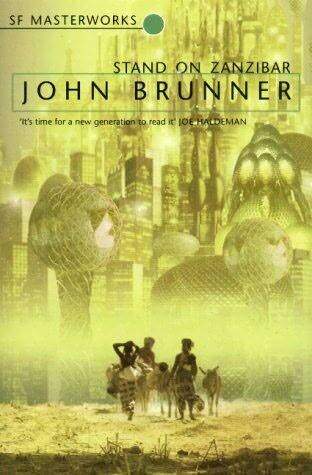
Some troubledom just figured that if you allow for every codder and shiggy and appleofmyeye a space one foot by two you could stand us all on the six hundred forty square mile surface of the island of Zanzibar.
John Brunner is the type of author that you should be careful with. His work could be easily divided into different periods, and not all of those are equally good. However, there is no question of quality when it comes to his cycle of catastrophic SF books. Stand on Zanzibar is a colossal work - both literally, and figuratively. Completely revolutionizing the stylistic conventions of SF, it is one of the most significant pieces of dystopian fiction I've ever read, and a shining example of the many ways New Wave reinvented the genre.
Forty-year old predictions are rarely any good, and when you reach the year of an SF novel's "distant future", it is easy to smirk at the author's naivete. Not so in this case. Even if Brunner's vision did not come entirely true, the patterns he saw decades before mostly anyone else, are undeniable. And we can't really smirk at Stand on Zanzibar without the little nagging feeling that its prediction is just biding its time.
The year is 2010 and the world has gone crazy. Population has long since passed the seven billion mark, and the twenty first century is a whirlwind of hysteria. Computers on the verge of becoming AI take humanity's decisions for it, drugs are legal and used by everyone; politics are done through assassination in the shadows, and scientists burn incense to appease volcanoes. People could turn into mass murderers for no reason whatsoever while simply crossing a street, commercials are all over the place and Mr. and Mrs. Everywhere have your faces and speak with your voices while taking you through your TV to places where you could never go in the real world. And as every advanced country has accepted laws for genetic purity that deny anyone with hereditary diseases the right to reproduce, and tensions between the superpowers constantly escalate into armed conflicts, two small countries focus the world's attention on themselves.
Beninia is a fictional African country that should have been assimilated by its more powerful neighbors, but for some reason hasn't been. And even though it is poor and underdeveloped, there are no internal conflicts there, while the rest of the world devours itself. Meanwhile The Enlightened Democracy of Yatakang (another fictional country, possibly cover for Indonesia) makes a startling announcement - a break-through in genetic engineering that could change the world forever.

The pacing of the story is slow and measured, but the plot is just one of many devices that John Brunner uses to paint the mad reality of a world where people are packed so close to each other that they've reverted to a state of neo-barbarism that I am pretty sure wasn't nearly as plausible in 1968 as it is today. Stand on Zanzibar is as much a warning as it is a prediction, and a disquieting quantity of elements from its monstrous reality are all too easy to recognize in our own. The author has been meticulous with every detail of his world. The book is written in an entirely fictional slang - a mirror of the hysterically fast day-to-day lives of the people in this dark twenty first century. Every other word is a combination of two longer ones. Everything is shortened, simplified, mass-produced, a tool for word-games. "Bastard" is no longer an insult, but "Bleeder" is - there is no greater fear than being found to have a hereditary disease. Drugs are so widely used, that everyone is "out of" or "in orbit", depending on whether some form of communication has been achieved.
The panoramic view of Stand on Zanzibar's world shows us a number of social phenomena. There are the "shiggies" - a class of women that have no home of their own (living space is now the greatest luxury and even the richest could rarely afford an apartment of their own) but change partners and live with them. Tobacco is no longer used, but marihuana is legal and more widely used than tobacco ever has been. But the most frightening example of Brunner's dystopian society are the "muckers". Derived from "amock", the word is used to describe people who couldn't stand the pressure and rhythm of their lives. When they break, they turn into mindless berserkers, killing sometimes scores of people before being killed themselves. Even without the muckers, the world is filled with terrorists and saboteurs, often wreaking havoc and destruction just for the heck of it, as a hobby. Humanity's drive for self-destruction, fueled by something as simple as lack of space, is one of the most powerful points of the book, and one of the most horrifying.
Meanwhile, back at planet Earth, it would no longer be possible to stand everyone on the island of Zanzibar without some of them being over ankles in the sea.
Stand on Zanzibar's most interesting quality, however, is the structure. Its chapters are more or less equally divided between four completely different categories, but mixed together and following no distinguishable order. Each chapter starts with the label of its category and there are four separate contents for each, although reading them separately seems to me to be completely pointless.
continuity is the main story-arc that follows the few "main" characters of the book and the events around the countries of Beninia and Yatakang. Although Brunner isn't overly concerned with character development, the protagonists are still fully developed and believable. The story itself is nothing special and on its own wouldn't merit any attention. Good thing it's not on its own.
context gives us background information on Stand on Zanzibar's world through different means - news snippets, articles, book excerpts or interviews with various people.
tracking with closeups follows little story-lines that have nо influence over the continuity line (although a few tracking characters appear there in minor roles), but give broader view of Brunner's Earth of 2010. Almost none of the lines appear in more than two tracking chapters, and yet characters are just as fleshed-out as those in continuity.
the happening world is possibly the most innovative and atmospheric part of Stand on Zanzibar. It is also the hardest to digest. It follows context's idea, but goes to the extreme. Each happening world chapter is a seemingly random collection of little pieces of commercials, messages, word-games, songs or other symbols of this new world. Brunner plays a lot with rhythm in those parts of the book and combines different snippets in monolithic walls of text, changing the source faster and faster until every word comes from a different place and the reader feels like his or her head is about to explode.
Stand on Zanzibar uses those four drastically different ways to offer its content, but all of them are united under the single purpose of world-building. The effect is so powerful, that at times I wanted to close the book just to catch my breath. The psychic intensity of the novel could actually be partly a weak point. The information overload is intentional, but that doesn't make it any less... well, overloading. This is not a book you read in huge chunks. It is just too intense for that.
That said, Stand on Zanzibar is still extremely engaging. It pulls you in and never lets go, even when you want to take a break from its psychedelic, self-destructing world. True, it is a bit outdated - computers haven't been taking up whole rooms for decades, and we're halfway through 2010 already - but Brunner's tale of an inverted apocalypse is still so shockingly plausible and compelling, so thought-provoking and unsettling in its accuracy, not to mention so darn well written, that it fully deserves a place in SFF's hall of fame.
10/10
Jul 3, 2010
The Prince of Nothing Trilogy - R. Scott Bakker

I read Scott Bakker's fantasy trilogy a few years ago, and it instantly turned into my favorite work in the genre. The rich world-building, magnificent style, the awesome central character, and the scope of the story are something I am yet to see in another fantasy series. It is also one of the greatest examples of how the genre could be so much more than entertainment, weaving into the story thoughts on religion, faith, and most importantly - the extent to which anyone could ever know himself. And so now, while we wait for The White-Luck Warrior - second installment in the second trilogy in the larger arc of The Second Apocalypse - I thought to pay a tribute to this amazing series by writing about it.
The story is set in a world, resembling our pre-medieval ages. Two millenia ago the great Norsirai civilizations of humanity were destroyed in the Apocalypse - a monstrous war between men and Mog-Pharau - the No-God - and its Consult. The conflict finally ended in a victory, but the North was left a wasteland, inhabited by the abominations, created by the Consult. Civilization now thrives in the southern Three Seas - a multitude of nations, sharing Inrithism, the religion of the Thousand Temples... but little else. The Apocalypse is now just tales and superstitions to all but the School of Mandate - sorcerers who each night relive the devastating war through the eyes of their founder - the great sorcerer Seswatha. They know the Apocalypse happened. And they know the No-God was not killed and the Consult still waits to unleash terrible destruction on the world of men.
The countries under the religion of Inrithism are now at the threshold of a Holy War with the heathen Fanim from the desert kingdom of Kian - by far the largest nation in the Three Seas. The Inriti are bound for Shimeh - the birthplace of the Latter Prophet Inri Sejenus. And as different factions are trying to bend the Holy War to their own ends, and the fragile balance between the the Great Powers - kingdoms, empires, the Thousand Temples and the Few and their sacrilegious sorcerous Schools - is about to be smashed to pieces, into the world comes a variable that no one could have predicted. In a distant secluded citadel far in the savage North, the Dunyain - a strange order of monks - have survived in perfect isolation for two thousand years. Bred for passionless intellect, mental and physical perfection, they have turned themselves into something more than human in search of the Absolure - the Self-moving Soul, unbound by any circumstance, moved by nothing but its own will. And now one of them, a man named Anasurimbor Kellhus, is sent to find his father... and kill him.

Drussas Achamian - a Mandate sorcerer and spy - follows the Holy War looking for traces of his School's old and elusive enemy, the Consult. Esmeneth is his lover - a prostitute from the city of Sumna, cradle of the Thousand Temples, and her fate is also bound to the Holy War. Cnaur urs Skiyotha is a Scylvendi barbarian from the western steppes - a heathen amidst the righteous Inriti, incapable of escaping the pull of hatred and madness that have been brewing in his heart for thirty years. Those three are connected to Kellhus in more ways than they could imagine, but only Achamian knows what the Norsirai's arrival means. Because the last king of the great kingdom of Kuniuri - now two millenia destroyed by the No-God - was an Anasurimbor. And before he died, he uttered a prophecy that one of his blood would return... at the end of the world.
The time has come for the Second Apocalypse and the rebirth of Mog-Pharau. And Achamian has to find a way to warn the many nations of the Three Seas of an enemy none of them believe in, and prepare them for a war they think just mere legends. But no one could prepare the Three Seas for Anasurimbor Kellhus.
The Prince of Nothing trilogy tells the story of the Holy War. It is the story of one man who tries to bend the world to his will amidst a conflict of epic proportions. And it is a story of sorcery and religion, of zealous faith and poisonous ambition. A huge cast of characters is used to paint the many faces of the Holy War, each of them ugly in one way and beautiful in another. Scott Bakker's style of writing is amazing - both rich and exact, with an unbelievable eye for thrilling detail, creating with seaming ease an atmosphere of epic events and ancient pathos. One that so many fantasy authors spend their whole careers trying to achieve, but never come close to. But the gorgeous prose and the grand story Bakker tells with it are only a part of what makes this trilogy so good. I already mentioned the complex characters. The author uses those to engage in musings about faith and self-analysis sometimes bordering on the obsessive.

As for the fantasy elements, I don't think I've ever read more glorious description of magic. In The Prince of Nothing's world sorcery is a force of annihilation, a power that tears the fabric of reality, creating wounds that the Few could see. And yet this horrible devastation is delivered through song, the sorcerers singing as their eyes and mouths blaze with blinding light. The way Bakker describes the feeling of the impossible words capable of hurting the world itself, is so poetic and at the same time so intense, that every scene involving sorcery literally sent shivers down my spine. This is one of the many instances where the author has intertwined his philosophical education with his writing, and gives us three different kinds of sorcery. The Anagogis, used by all the Schools but one. It depends on the great Analogies to weave its destruction, but they also bind and limit its power. The glorious Gnosis, magic of the Ancient North, now known only to the School of Mandate. It is the most heavily guarded secret in the Three Seas, and one coveted by all the other Schools. The Abstractions of the Gnosis hold unimaginable power, not restrained by visualization and specific meaning like the Analogies. And then comes the mystical Psuhke, arcane practice of the Cishaurim - Kian's sorcerer-priests. Cruder than both the Anagogis and the Gnosis, it is unique in that its effects are undetectable by the eyes of the Few.
I could go on gushing into ponderous retelling of the story, characters and world, but it would be pointless. I could never do The Prince of Nothing enough justice. It is the single greatest FINISHED fantasy series I've ever read, and one of the most significant pieces of Speculative Literature in my experience. The only way to get a feeling of its epic story and brilliant world-building, the awesome magic system, or the multilayered characters and their tumultous relationships, is - wait for it! - to just read the books. They are not separate, and represent the beginning, middle and ending of a single story. But believe me - The Prince of Nothing is well worth the time investment!
10/10
Jul 2, 2010
Wastelands: Stories of the Apocalypse

I am a sucker for thematic short story collections. Although I respect "best of the year" books, there is something much more focused in an overarching theme. Years could be generally weak (although, thankfully, recent ones haven't been), and so the "best of..." collection suffers. But with themes you just know that if the editor has done his or her job, it is going to be good.
That said, I am an even bigger sucker for apocalyptic SF. Not the Mad Max b-movie kind, but the thought-provoking, inventive, chilling predictions of the many, many ways in which civilization or the world as we know it could be destroyed. So, naturally, when I noticed the gorgeous cover of Wastelands, and then the names written on it, I simply had to read it.
In one word, this apocalyptic collection is superb! The amount of genuinely brilliant fiction inside is staggering. John Joseph Adams has opted for established names, and those deliver stories that range between light-hearted quests - such as Jack McDevvit's Never Despair (set in the universe of his post-apocalyptic novel Eternity Road) - and poetic pieces like Gene Wolfe's delicate and silently horrifying Mute. There are tragic tales (George R. R. Martin's beautiful Dark, Dark Were The Tunnels) and there are tales of violence and strife (Paolo Bacigalupi's The People of Sand and Slag). And above all lies the theme of a world that has been, but is no more. An idea that holds as much hope as it does horror.
Two stories deserve special mention:
One of the most original entries in this collection is Octavia Butler's Speech Sounds in which the "apocalypse" has appeared in the form of a disease that renders most of humanity incapable of recognizing and producing speech or written words. People have reverted to a deteriorating primitive society that resorts to violence as the alternative to communication. But the effects of the disease are not passed to further generations, and hope is born anew.
Dark, Dark Were the Tunnels by George R. R. Martin has to be my favorite story in Wastelands. A few centuries after a nuclear war has destroyed Earth's surface, a form of humanity has survived deep underground, developing telepathic connection to the mutated animals that also dwell in the tunnels. Then a shuttle from the dying Moon colony - the only remnant of an age long gone - lands in search of survivors and resources. And the meeting between the two civilizations is not what any of them might expect.
Of course, not all stories in this collection are equally good. Stephen King's The End of the Whole Mess is more or less Stephen King being his usual manipulative self, using easily recognizable ways of extracting the appropriate reaction from his readers. Orson Scott Card's Salvage on the other hand - part of his "Mormon Sea" cycle - could very well be set on an alien planet with no change of setting whatsoever. The apocalypse has happened a long time ago, and Card is a lot more interested in exploring his religion than anything else.
Still, there isn't even one weak story in Wastelands, and the good ones are pure joy. Adams starts each entry with an introduction to both the author, and the story itself, and I found many of those really interesting. There is also a "For further reading" list at the end of the book, which contains almost every work of apocalyptic SF that's worth its salt.
All in all, Wastelands: Stories of the Apocalypse is as good as they get. There are both new, and old names, an amazingly wide range of themes and styles, and an overall quality that is truly rare even in this type of collection.
8.5/10
Jul 1, 2010
SF Masterworks: UBIK - Philip K. Dick

I've always been deeply in love with Philip Dick's paranoid worlds. I love his books, I love his short stories, I even love things like Our Friends From Frolix 8. There is something raw and razor-sharp, almost clinical in Dick's writing, something that transcends style, ideas and story. You can always tell that a part of him - and it might very well be a dominant part - not only believes in what he writes, but lives it.
I haven't read all of Dick's books. I haven't even read half of them. Still I've read most of those whose names everyone knows, and I have read enough to think that even a genius of his magnitude would be hard pressed to write anything quite as good as Ubik twice. If I had to point at a single one of Philip Dick's works as his magnum opus, that would undoubtedly be it.
As Michael Marshall Smith aptly puts it in the forward of my edition of the book, there is a mind-boggling number of SF ideas in Ubik: time-travel; psychic abilities and their corresponding anti-abilities; the dead being kept in a state of "half-life" where they could be reached by the living; alternate realities and reality revision; futuristic space-faring society; dystopian economic system. Many authors would spin a book around any ONE of those, but for Philip Dick it's always what's underneath the flesh that matters, so he casually presents them ALL in the first ten pages of his novel.
In Ubik's world technology has advanced to the state where colonization of the Moon and other worlds is possible. Psychic phenomena are common and many people employ psychics in their business ventures or shadier dealings. And since no law could control such powers, the so called "prudence organizations" have appeared. Those who work in them have the ability to negate one psychic power like telepathy or precognition. Meanwhile, people could be put in "cold-pac" after death - a half-life existence that slowly diminishes until the person dies again, this time - forever.

The main character, Joe Chip, is a technician for Glen Runciter's prudence organization. When a client hires twelve agents to negate telepathic spies in his lunar facilities, Runciter and Chip travel with them to the Moon. The assignment turns out to be a trap, possibly set by the company's nemesis Ray Hollis (who leads an organization of psychics), and Glen Runciter is killed in the ensuing explosion. The party quickly returns to Earth to put him in cold-pac.
But afterwords the twelve agents and Joe Chip begin to experience strange reality shifts. Food and drink deteriorate prematurely, and the world seems to regress into the past. What's more disturbing, they all receive messages from Glen Runciter, implying that it is actually he who is alive, and they who are in cold-pac. And above all is the ever-present Ubik, appearing in commercials on TV and radio. Nobody knows what it is, but it is everywhere. And it is important.
Then the deaths begin...
Ubik is a deeply unsettling book. The characters' hold on reality is at best loose, and the uncertainty they feel as to the nature of their very existence seeps into the reader's own mind, turning the novel into almost a horror story. When the action and the race (quite literally) against time begin, you are almost grateful for the opportunity to evade the disturbing questions concerning what's real, what's not, and which one is more dangerous. Dick's misleadingly simple language and the traditionally schematic relationships between his characters, only seem to accentuate the unnatural events he is painting.
Philip Dick is a master of multiple realities that intertwine and overlapp until the mind's ability to grasp it all simply fails, and madness begins. As Paul Di Filippo says in a review of the book, "No reality is priveliged". Nowhere is Dick's ability to test the limits of perception and self more strikingly demonstrated than in Ubik. And even if you take nothing from the book, but the amazing mystery and suspense filled story, it would still have been one of the most satisfying reading experiences you've ever had.
10/10
Play Dead - Ryan Brown

I bet everyone knows that feeling, when you need something completely brainless to read, just some relaxing dumb fun. Sometimes you don't even know you need it, until you bump into the right book. I was browsing my local bookstore, looking for Clive Barker's Weaveworld, when I suddenly saw that awesome kitsch cover. Then I read the blurb, and I was hooked. Suddenly Play Dead was just what I needed to read.
Also, look at the author. You can't say no to this smile!

So, anyway. The story is set in a little Texas town called Killington. On the morning before a major football game, high-school quarterback bad-boy Cole Logan (I'm wondering if that's not a little subtle, Ryan. Should've named him Brock Jockson; then we'd be sure he's a bad boy) is attacked in his front yard and has two fingers of his left hand cut. The assault comes with a warning - if he doesn't back from the game, his teammates could be next. Being a bad boy, Cole laughs in the face of danger and proceeds to announce in front of the whole school that the game is on, while bleeding almost to death in the process. It turns out the game is not on for him, because the coach forbids him from playing, but the enemy - the big champion team from the neighboring town of Elmwood - doesn't know that. So the Killington Jackrabbits bus ends in the river and the whole team except for Cole and the coach drowns. But being a really bad boy, Cole doesn't let things go, and with the help of mystical cat-loving lonely widow and football fan Black Mona, he raises his teammates back from the dead. However, they are not quite alive, and what's worse, they have only two day before they change into mindless flesh-eating monsters. In that time they must win a game against the Elmwood Badgers, or their souls will be damned forever. So Cole sets on a desperate quest to help his tortured friends, with the help of gorgeous-yet-intelligent Savannah, daughter of the coach and reporter for the school paper.
Yes, Play Dead is exactly as ridiculous as the synopsis suggests. It is corny, takes itself WAY too seriously, and is filled to bursting with football heroism. In one word, it is gorgeous! Ryan Brown's debut reads with the speed of light, and the feeling of white trash supernatural midwest horror is one I've always enjoyed. The book is poorly written, with pages of one-line dialogue, delivered by half-dimensional cardboard characters. There are infodumps galore, integrated with the subtlety of Cole Logan's name. But somehow it's all way too cool for the reader to really care. The language is simple, but does the job, and the sloppy style doesn't slow you down.
So, this is a story about zombies fighting for their souls with the help of heroic characters, who overcome their personal flaws in the process. In a football game. If you can read this description, and still think Play Dead might be the book for you, then take it from me - it most certainly is!
6/10
Subscribe to:
Posts (Atom)