Showing posts with label Ian Cameron Esslemont. Show all posts

Sep 8, 2011

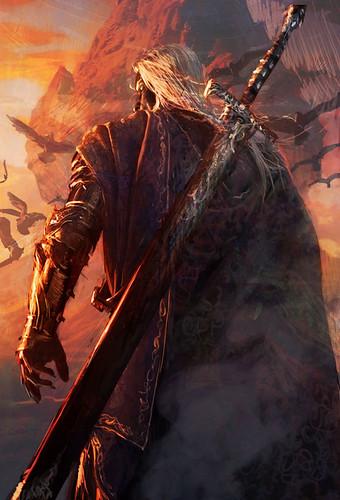
Cover art for Ian Cameron Esslemont's Orb, Scepter, Throne


It's pretty awesome, but at this point I care very little for the Malazan world. I am yet to read anything by Esslemont after Night of Knives, and I haven't even finished the original Malazan series. Talk about disappointment.

Anyway, Orb, Scepter, Throne is set in Darujhistan and is a sequel to Toll the Hounds.

Aug 15, 2010

Malazan: Novels of the Malazan Empire - Night of Knives


Something very strange happened in 2003. Suddenly it was announced that Steven Erikson was not the sole inventor of the Malazan world. He had a partner in crime - the Canadian archeologist Ian Cameron Esslemont. According to what Erikson revealed in interviews, they co-created the world as an RPG setting back in the early 80s. After that they agreed to both write books in it, sharing some story-lines but generally focusing on different aspects of the Malazan tapestry. Currently, Esslemont's Novels of the Malazan Empire are two - the short novella-like Night of Knives and the longer Return of the Crimson Guard - with the third one, named Stonewielder, expected to come out by the end of the year. He states that he is planning at least three other books in the series.

Night of Knives was first published in 2004 as a limited edition hardcover by PS Publishing. I still remember how impatient I was for it to come out. It was a time when I was still madly in love with the Malazan world, and the discovery of another voice telling tales in it was great news to me. The book is set between the prologue of Gardens of the Moon and the "present", within a 24 hour period on the island of Malaz, following the events that saw Empress Laseen ascend the throne of the Empire. There are also some Jaghut shenanigans, some guest-stars from the Book of the Fallen and a few really cool flashbacks showing the First Sword of the Empire - Dassem Ulthor himself. What the book also has, unfortunately, is the annoying cliche teenage heroine Kiska who - we were to believe at the time - would play a part in Erikson's books as well. Thankfully, said "part" represented a half-page cameo in the background of a scene in The Bonehunters, but this doesn't give Esslemont any points for going the way of annoying cliche teenage heroines.

Night of Knives is - honestly - nothing to write home about. It is mildly cool in a spin-off way, but it adds nothing to the backstory of the Malazan world, even though it is set in one of the most important moments of the Empire's history. And since at the time it was marketed as really important to the world-building, some disappointment was inevitable. Esslemont's writing is adequate, but couldn't compare to Erikson's in his good years, and unfortunately Night of Knives was published right after Midnight Tides - arguably the best of Erikson's work - so the comparison wasn't in the new installment's favor.

Still, the book is far from bad. It is just not on the scale of what the reader is used to when dealing with the Malazan world. More of a spin-off novella than the beginning of another epic Malazan story (which was, btw, originally the case - it was years later that Night of Knives came to be regarded as the first in a series, instead of a prologue to one), it just lacks enough focus to deliver anything more than mild entertainment. If you are a fan, you will enjoy it immensely, but if you aren't, this book isn't a good place to start. From what I hear, the following Return of the Crimson Guard is a vast improvement both in terms of plot, and writing style, but I haven't yet found the courage to try it. I will though, at some point, because Esslemont deals with story-lines that I really care about, some of which - like Silverfox and her T'lan Imass army - started in the Book of the Fallen. I can only hope that the Novels of the Malazan Empire will get better with each new installment This world has a lot to offer still, and if Esslemont is able to deliver an epic of his own, than what could be better?

6.5/10


Next: Malazan: The recent books - The Bonehunters

Jul 14, 2010

Malazan: An Introduction, Part II


...continued from Malazan: An Introduction, Part I

While the conflicts of the four Founding races teared the world, a different war raged in Kurald Galain, the Elder Warren of Darkness. Mother Dark, creator of the multiverse, had committed a sin in the eyes of her children - the Tiste Andii - by giving birth to Light. Anomander Rake, her second son, led a small group of his race into the Malazan world, swearing never to return to the mother that turned her face away from her firstborn. Others followed him later, together with their new cousins - the Tiste Edur, Children of Shadow, born from the congress of Light and Darkness. The Andii and Edur fought a war with the already declining K'chain Che'Malle and won, but a betrayal from within led to the near decimation of the children of Darkness. In the end, Anomander Rake's followers were among the few who survived, while the Edur left for a distant land. The Son of Darkness now dwells in a flying mountain called Moon's Spawn, pledging the help of his people to causes not their own, as even though they can use the powers of Kurald Galain, entry to their home Warren is forever denied to them.

Powerful beings walk the Malazan world. Some of them manage to obtain godlike powers and immortality. The paths to Ascension are many, and the Ascendents assume different roles. Some, like Anomander Rake, lead their people, denying their attempts to revere them. Others grasp at godhood, gathering followers or slaves and feeding off their faith. But just as not all Ascendants are gods, the opposite is also true, for there are gods that were never mortal. Some were part of the forces that shaped the multiverse, while others were called into being by the myriad beliefs of civilizations sometimes long gone.

Many other powers form the balance of the world, such as the shapeshifting Soletaken and D'ivers; the sentient Houses of Azath that sprout at random places to imprison in their grasp everything that threatens the order of the multiverse; the draconean Eleint, children of the dragon goddess Tiam and Starvald Demelain, the First Warren; and a plethora of other creatures, races and groups that wage war on each other, form alliances and play in the games of intrigue that span worlds and centuries.

***

It is easy to lose oneself in the labyrinth of the Malazan world, with its myriad factions, ridiculously overpowered characters and ceaseless conflicts. What I've spent two posts in describing is never presented in such a synthesized form. Steven Erikson never explains anything outright, and sometimes different points of view present conflicting information. And yet, it is all there, and it quickly starts to make sense. Even when you feel you've been thrust in the middle of an unfamiliar place with its unfamiliar history and a vast cast of characters you know nothing about at the beginning of Gardens of the Moon, the story just propels you forward, until suddenly you realize this grasping for firm knowledge is unnecessary. Because, especially in the first half of the Malazan Book of the Fallen, you become part of this world. And as such, you can't ever truly know the whole picture - not until you've lived through it.


Next: Malazan: The early books - Genabackis

Jul 13, 2010

Malazan: An Introduction, Part I


I was first introduced to the Malazan Book of the Fallen around the time that book five, Midnight Tides, was coming out. By that time my fantasy experience had been pretty standard, with names like Jordan, Martin and Feist comprising the core of my knowledge of the genre. Then along came Steven Erikson and knocked me off my feet, changing my whole perspective of the field. Here was a series of such epic proportions, a vast world of such immense historical depth, and a cast of characters of such magnitude and diversity, that I could not believe a single person could have invented it. I was later to learn that it were actually two people that invented it, but at the time Esslemont's name was still unknown.

I fell in love with the series, and it bordered on religious adoration until book six, The Bonehunters arrived. Even then I retained most of my good feelings for the Malazan world, but then came books seven and eight, and the magic was mostly gone. But the journey is not over (and neither will it be over when the final tenth installment of Book of the Fallen comes out, since there are many more tales in this universe), and I am yet to read book nine too. But although my feelings for the series are somewhat colder now, I still consider the first five books to be among the greatest examples of what Fantasy has to offer. There has never been another work in the genre that deals with events of such magnitude, on such a broad scale and with so many fully developed characters.

So I decided to write a series of posts on the topic. Not exactly reviews, although the latter ones may turn out to be such, but more an overview of the Malazan world. I am not entirely sure how many posts there will be, although I am guessing the number will be around five or six. There will be no spoilers, although some of the stuff written bellow might be more fun to dig out on your own. Still, I'd like to think that it is safe to read my ramblings without fear that they would ruin your enjoyment of the books if you haven't read them yet.

And here we go.

The Malazan world is a place of ancient secrets and devastating cataclysms. Powerful godlike beings dwell on its many continents among races both old and young, human and inhuman. It is a world of layers, where what has happened before never disappears, but sleeps under the feet of civilizations rising and falling for hundreds of thousands of year, waiting to be awakened. It is the center of a multiverse created by Mother Dark, one through which the blood of an Elder God flows freely to create the streams of magic.

As the story begins, we are introduced to the powerful Malazan Empire. A century ago a band of rogues captured a small pirate island off the coast of the continent of Quon Tali. Led by the charismatic Kellanved, those extraordinary people created the heart of what was to be a power to conquer half the known world within less then three generations. At the time of the first book, the Empire controls three continents and wages wars of conquest on two others. Its armies are the finest fighting force in the world, as the brilliant Malazan leaders have paid heed to the lessons of innumerable civilizations that have preceded them. But the Empire is only the beginning for its creators.

Outside, inside, over and under this world are the Warrens - pocket dimensions, through which mages can both travel and access their magic. Some of the Warrens are aligned to an element or a god. Others are the birth places of the world's races. Many are not accessible to humans. They are both places and the road to places. Sources to power and knowledge. And some of them have preceded the Malazan world itself. Magic is always fluid in the Malazan series. There is the ordered system of the Warrens. But there is also the magic of ancient spirits and shamanism. There is the power of faith and symbolism, and there is the power of curses that span millenia. And those often merge to create mind-blowing effects, especially in the first few books.

The Malazan world is populated by many sentient races, and all of them are original creation of Erikson and Esslemont. No elves and dwarves here. First, the Four Founding races:

The ancient prehistoric progenitor of humanity, the Imass, made the ultimate sacrifice to wage a war of utter extinction on beings who had the power to trap whole continents in a prison of ice. They became the undead T'lan Imass - immortal and indestructible creatures of dust and fire who can not find rest as long a single one of their enemies still breaths. But the mortal was never meant to endure the weight of immortality, and as hundreds of thousands of years pass, the T'lan Imass' souls have turned to dust, and of memories of ice.

The Jaghut were once the rulers of the world, after the decline of the K'chain Che'Malle. Creatures of Omtose Phellack, the Elder Warren of Ice, they were forced to live alone by their own power, as the conflicts between Jaghut could tear down continents. As they themselves had once been slaves, so too did they enslave the hapless Imass, posing as gods for no other reason but the joy of control. Too late the Jaghut realized the threat that loomed beyond the horizon, and even as the last Jaghut Tyrant was cast down by his own kind, the immortal T'lan Imass emerged to drive their race to near extinction. Three hundred thousand years later the immortal Jaghut still pay for their hubris.

Little is know of the lizard-like K'chain Che'Malle, except for the fact that they came from beyond the stars, and used technologies that the world has not yet rediscovered. Their Matrons possessed powerful magic and utter control over their broods. Until a new experimental breed turned too volatile to control, and the ensuing civil war destroyed the K'chain Che'Malle civilization, opening the way for the emergent Jaghut.

Even less is known of the mysterious Forkrul Assail. They were creatures of limitless power, almost indestructible, with tremendous physical strength and near impervious to magic. The Assail never formed any sort of culture, nor did they have connections to the other races of the world. Obsessed with balance, their only interaction with others was to come when imbalance was perceived, to unleash a genocide of apocalyptic proportions and then vanish again. At the time the series takes place they have disappeared, although some remain in remote places.


To be continued...


Next: Malazan: An Introduction, Part II