
Showing posts with label Steven Erikson. Show all posts
Showing posts with label Steven Erikson. Show all posts
Aug 5, 2011
New cover for Subterranean's special edition of Deadhouse Gates
After the less-than-inspiring cover that was released about a month ago, Subterranean released a new one, and I dare say it looks way better. Also, the scene depicted on it makes a lot more sense as cover art.


Jul 8, 2011
Deadhouse Gates limited edition

The limited Subterranean edition of Steven Erikson's Deadhouse Gates finally has a cover. I want to say something nice, but it looks pretty uninspired to me, and way more forgettable than the Gardens of the Moon one. Also, It would seem to me that when you are publishing a 10-book series, you don't want to wait for four years in between books.
Anyway, if you are interested, here is the link to pre-order it.
Mar 28, 2011
Another Game of Thr... No, just kidding!
This one is about Steven Erikson, and more particularly, the US cover for his fourth Malazan novella, Crack'd Pot Trail. I still haven't read any of those, and have no particular interest to either... Anyway, here is the cover, followed by the blurb:


It is an undeniable truth: give evil a name and everyone's happy. Give it two names and . . . why, they're even happier.
The intrepid necromancers Bauchelain and Korbal Broach, scourges of civilization, raisers of the dead, reapers of the souls of the living, devourers of hope, betrayers of faith, slayers of the innocent and modest personifications of evil, have a lot to answer for and answer they will. Known as the Nehemoth, they are pursued by countless self-professed defenders of decency, sanity and civilization. After all, since when does evil thrive unchallenged? Well, often: but not this time.
Hot on their heels are the Nehemothanai, avowed hunters of Bauchelain and Korbal Broach. In the company of a gaggle of artists and pilgrims, stalwart Mortal Sword Tulgord Vise, pious Well Knight Arpo Relent, stern Huntsman Steck Marynd, and three of the redoubtable Chanter brothers (and their lone sister) find themselves faced with the cruelest of choices. The legendary Cracked Pot Trail, a stretch of harsh wasteland between the Gates of Nowhere and the Shrine of the Indifferent God, has become a tortured path of deprivation.
Will honour, moral probity and virtue prove champions in the face of brutal necessity? No, of course not. Don't be silly.
Jan 5, 2011
The books I'm expecting in 2011
This is just a short list, and I haven't put that much thought into it, but I felt the need to write down the books I'm most eager to read in order of their anticipated awesomeness.

1. The White Luck Warrior by R. Scott Bakker
Even though I was slightly disappointed with The Judging Eye (there will be a review soon, after I reread it), I still can't wait to read this one. The Prince of Nothing trilogy is by far my favorite work of fantasy, and I trust Scott Bakker to deliver again with The Aspect Emperor.

2. The Wise Man's Fear by Patrick Rothfuss
For whatever reason, it's always been extremely hard for me to explain why I like The Name of the Wind so much. It is more or less a generic "orphan goes to school to become a great magician" story, but it felt neither generic, nor cliche. I am planning to reread this one as well, and I hope I can pinpoint what makes it so good. That said, The Wise Man's Fear took its sweet time, risking to put Pat Rothfuss in the same basket where George Martin is happily writing A Dance With Dragons with one hand, while supposedly programming Duke Nukem Forever with the other or something like that. Which would not be an issue, had the series not been promoted as an "already written" kind of deal, and had Rothfuss not been a writer with only that one successful book under his name. Still, the waiting is almost over and The Wise Man's Fear will be awesome. I just know it.

3. Embassytown by China Mieville
Probably not for the first time, I have to admit to the terrible shame of having never read an entire China Mieville book. It's not that I don't want to, I actually crave to! I just never seem to be able to get around to it. So, apart from about 250 pages from Perdido Street Station, read before the dawnatime, I have no experience with Mieville. However, I know enough to know that I have to read Embassytown. This writer, doing a space opera? Yes, please!

4. Home Fires by Gene Wolfe
Gene Wolfe is the greatest living writer in the speculative field area. That doesn't always make him the most interesting or approachable one, but it's a nice thing to be, none the less. I am not always in love with his fantasy, magical realism and mystical works in general, but his SF is always spot on, and terribly, terribly engrossing. Home Fires promises the usual Wolfeisms - confusing identities, stories within stories, and weird romance. In a futuristic setting. What more can the heart desire?
5. The Alloy of Law by Brandon Sanderson
Say what you want about Sanderson, his Mistborn trilogy was one of the best fantasy works I've read in years. So, when he announced that 2011 will see the publication of a stand-alone novel set in the same world, but 300 years in the future, in a society much more technologically advanced than the Final Empire... well, appetites have been whet. There is still very little information about this book, particularly concerning its release date, but I am fervently hoping it's around the summer. The Alloy of Law would make for awesome summer reading!

6. The Crippled God by Steven Erikson
Had you asked me three years ago, this book would be at the top of the list. However, the Malazan series is not what it once was, and I have utterly lost faith in Steven Erikson's ability to deliver a satisfying conclusion to it. I have been so disinterested lately, that I haven't even gotten around to reading Dust of Dreams (that will happen soon, however, followed by a review of the book here). Still, it has been a long ride, and at least the first half of it was quite memorable. Hoping against hope has always been appealing to me, so here's to hope!

7. The Scarab Path by Adrian Tchaikovsky
Yes, yes, I know this book is already out in the UK. But the Pyr editions are so much more... well, beautiful. Plus, I am yet to finish Blood of the Mantis, so there's no rush. Tchaikovsky's Shadows of the Apt series is slowly finding its pace, and getting better and better with each installment. I have been told that Salute the Dark marks an ending to the current story-arc, which means that The Scarab Path would be the beginning of a new one. I admit I'm curious as to how Tchaikovsky will handle that with the experience he's acquired since Empire in Black and Gold.

8. The Cold Commands by Richard Morgan
Just like Mieville, the next two places on my list are left for writers I am really interested in, but haven't had the chance to check out. I've been meaning to read something by Morgan ever since Altered Carbon, but never got around to it. I am definitely planning to try The Steel Remains however, and if it's half as good as everybody says, then The Cold Commands should go a lot higher on my list.

9. The Heroes by Joe Abercrombie
I've heard so many good things about Abercrombie, that I just couldn't not put The Heroes on my list. The reason for it being so far back is that I am yet to even start The First Law trilogy, and considering my reading speed lately, it would be a long time until I get to this particular book. But I will get there! One has to believe in reaching for the stars!

10. By Light Alone by Adam Roberts
My first and only contact with Roberts was through one of his parodies - The McAtrix Derided. I did not fall in love with the book, and although there were a few really funny moments, the overall feeling I got was that the writer wanted to mix serious SF with a movie spoof, and it hadn't really worked. That said, since then I've read a lot of Adam's posts in his blog, and I have gradually warmed up to the idea of reading more of his work, preferably not spoofs, but his own stuff. By Light Alone seems like a wonderful place to do that, with its promised "Fitzgeraldian" futuristic New York atmosphere. I will be checking it out, that's for sure.

Honorary mention: A Dance With Dragons by George R. R. Martin
Yeah, I know. But for what it's worth, I think we have an actual shot at reading this book in 2011, even if it's a Christmas present. I wouldn't mention it though, if it weren't for the fact that I am currently rereading A Game of Thrones, due to the HBO show coming up (there will be review of it, btw, followed by other cutting edge reviews such as The Lord of the Rings and Conan the Barbarian! Stay tuned!). It was a good ten years since I last read it, and that wasn't in the original language either, so I am thoroughly enamored with it. As for Dance... well, time will tell.

1. The White Luck Warrior by R. Scott Bakker
Even though I was slightly disappointed with The Judging Eye (there will be a review soon, after I reread it), I still can't wait to read this one. The Prince of Nothing trilogy is by far my favorite work of fantasy, and I trust Scott Bakker to deliver again with The Aspect Emperor.

2. The Wise Man's Fear by Patrick Rothfuss
For whatever reason, it's always been extremely hard for me to explain why I like The Name of the Wind so much. It is more or less a generic "orphan goes to school to become a great magician" story, but it felt neither generic, nor cliche. I am planning to reread this one as well, and I hope I can pinpoint what makes it so good. That said, The Wise Man's Fear took its sweet time, risking to put Pat Rothfuss in the same basket where George Martin is happily writing A Dance With Dragons with one hand, while supposedly programming Duke Nukem Forever with the other or something like that. Which would not be an issue, had the series not been promoted as an "already written" kind of deal, and had Rothfuss not been a writer with only that one successful book under his name. Still, the waiting is almost over and The Wise Man's Fear will be awesome. I just know it.

3. Embassytown by China Mieville
Probably not for the first time, I have to admit to the terrible shame of having never read an entire China Mieville book. It's not that I don't want to, I actually crave to! I just never seem to be able to get around to it. So, apart from about 250 pages from Perdido Street Station, read before the dawnatime, I have no experience with Mieville. However, I know enough to know that I have to read Embassytown. This writer, doing a space opera? Yes, please!

4. Home Fires by Gene Wolfe
Gene Wolfe is the greatest living writer in the speculative field area. That doesn't always make him the most interesting or approachable one, but it's a nice thing to be, none the less. I am not always in love with his fantasy, magical realism and mystical works in general, but his SF is always spot on, and terribly, terribly engrossing. Home Fires promises the usual Wolfeisms - confusing identities, stories within stories, and weird romance. In a futuristic setting. What more can the heart desire?
5. The Alloy of Law by Brandon Sanderson
Say what you want about Sanderson, his Mistborn trilogy was one of the best fantasy works I've read in years. So, when he announced that 2011 will see the publication of a stand-alone novel set in the same world, but 300 years in the future, in a society much more technologically advanced than the Final Empire... well, appetites have been whet. There is still very little information about this book, particularly concerning its release date, but I am fervently hoping it's around the summer. The Alloy of Law would make for awesome summer reading!

6. The Crippled God by Steven Erikson
Had you asked me three years ago, this book would be at the top of the list. However, the Malazan series is not what it once was, and I have utterly lost faith in Steven Erikson's ability to deliver a satisfying conclusion to it. I have been so disinterested lately, that I haven't even gotten around to reading Dust of Dreams (that will happen soon, however, followed by a review of the book here). Still, it has been a long ride, and at least the first half of it was quite memorable. Hoping against hope has always been appealing to me, so here's to hope!

7. The Scarab Path by Adrian Tchaikovsky
Yes, yes, I know this book is already out in the UK. But the Pyr editions are so much more... well, beautiful. Plus, I am yet to finish Blood of the Mantis, so there's no rush. Tchaikovsky's Shadows of the Apt series is slowly finding its pace, and getting better and better with each installment. I have been told that Salute the Dark marks an ending to the current story-arc, which means that The Scarab Path would be the beginning of a new one. I admit I'm curious as to how Tchaikovsky will handle that with the experience he's acquired since Empire in Black and Gold.

8. The Cold Commands by Richard Morgan
Just like Mieville, the next two places on my list are left for writers I am really interested in, but haven't had the chance to check out. I've been meaning to read something by Morgan ever since Altered Carbon, but never got around to it. I am definitely planning to try The Steel Remains however, and if it's half as good as everybody says, then The Cold Commands should go a lot higher on my list.

9. The Heroes by Joe Abercrombie
I've heard so many good things about Abercrombie, that I just couldn't not put The Heroes on my list. The reason for it being so far back is that I am yet to even start The First Law trilogy, and considering my reading speed lately, it would be a long time until I get to this particular book. But I will get there! One has to believe in reaching for the stars!

10. By Light Alone by Adam Roberts
My first and only contact with Roberts was through one of his parodies - The McAtrix Derided. I did not fall in love with the book, and although there were a few really funny moments, the overall feeling I got was that the writer wanted to mix serious SF with a movie spoof, and it hadn't really worked. That said, since then I've read a lot of Adam's posts in his blog, and I have gradually warmed up to the idea of reading more of his work, preferably not spoofs, but his own stuff. By Light Alone seems like a wonderful place to do that, with its promised "Fitzgeraldian" futuristic New York atmosphere. I will be checking it out, that's for sure.

Honorary mention: A Dance With Dragons by George R. R. Martin
Yeah, I know. But for what it's worth, I think we have an actual shot at reading this book in 2011, even if it's a Christmas present. I wouldn't mention it though, if it weren't for the fact that I am currently rereading A Game of Thrones, due to the HBO show coming up (there will be review of it, btw, followed by other cutting edge reviews such as The Lord of the Rings and Conan the Barbarian! Stay tuned!). It was a good ten years since I last read it, and that wasn't in the original language either, so I am thoroughly enamored with it. As for Dance... well, time will tell.
Dec 27, 2010
Deadhouse Gates Limited Edition

Subterranean Press announced that the limited edition of Stephen Erikson's Deadhouse Gates is finally nearing publication. J.K. Drummond has taken the reins from the amazing Michael Komarck, as scheduling conflicts didn't allow the artist of Gardens of the Moon to continue with the project. However, Drummond is more than up to the challenge if the covers for Daniel Abraham's Leviathan Wept and Other Stories, Paolo Bacigalupi's The Alchemist and Tobias S. Buckel's The Executioness are any indication.
So far only the owners of Gardens of the Moon can pre-order the forthcoming Deadhouse Gates, but for anyone else interested, here's the page.
Oct 20, 2010
Cover art for Steven Erikson's The Crippled God


Sep 20, 2010
Malazan: The recent books - Toll the Hounds

A few months have passed since the siege of Capustan, and the continent of Genabackis is enjoying a time of relative peace. However, something is happening in Darujhistan, and this time maybe even ever capable Kruppe can't deal with it by himself. The few retired Bridgeburners running K'rul's Bar suddenly find out that there is a contract on their heads, as the Assassin's Guild begins to threaten them. Lady Spite arrives by sea, only to find out that her hated sister Envy is also in the city - and both of them know what terrible consequences their meeting would have. High Alchemist Baruk - leader of the decimated T'orrud cabal - learns that something has escaped Finnest House, and realizes that he has not the power to stop a new Tyrant. Meanwhile others travel toward the City of Blue Fire - Karsa Orlong and his witch companion Samar Dev, the mysterious Traveler and the High King Kallor, running from Tiste Andii vengeance.
But while mortals and Ascendants alike focus their gaze on the inevitable convergence in Darujhistan, the city of Black Coral - run by Anomander Rake and his Tiste Andii - has become the focus of another threat. Itkovian's sacrifice has liberated the T'lan Imass from the prison of their memories, but it has also created the new religion of the Redeemer. However, the emergent Ascendant's power is not in action, and so the Redeemer is helpless when a new god tries to corrupt the fledgling faith to his inhumane goals. And as Anomander Rake seems to be content with inaction, tension in the city rises. Meanwhile a group of young Andii travels through the continent, led by Nimander Golit and guided by the strange Clip, who wishes to confront the Son of Darkness. When they stumble upon the damage done by the Broken God, it seems that more than a quest for answers connects them to the events in Black Coral.
And while the two Genabackis cities struggle under the weight of impending apocalypse, a much bigger threat looms out of everybody's sight - Chaos has almost reached the wagon in Dragnipur. The Chained seem helpless to outrun it, because Anomander Rake has stopped killing with the sword, and so no new souls replenish their ranks.
Sounds awesome, right? It isn't. Actually, it is exactly this magnitude that completely rapes Toll the Hounds. In three paragraphs I've managed to list maybe a half of the story-lines in the book. And yes, ok, they are the more important ones, but there is still almost as much happening, and there are only so many pages to tell everything. The result is predictable - short five-page entries with one character/line switching to the next, and the next, and the next. Which means that no story-line moves more than an inch every time we visit it, and sometimes it's hundreds of pages before we get back to it.
The chapters themselves switch between Darujhistan and Black Coral, with characters outside of the cities put into the group they are associated with (Nimander Golit's band of rejects for example is obviously dealt with in the Black Coral chapters). Many old characters from both Gardens of the Moon and Memories of Ice make their reappearance, as well as some of the series ever-present continent-wandering ones like Karsa, Krokus/Cutter and others. In truth, the scope of Toll the Hounds could have been ok if a third of the minor lines (like Murillio's, the conclusion of which, incidentally, also made me insane with anger, but I'll get there in a second) were cut, and the rest were more focused, with less time spent on the usual Eriksonistic musings on how futile everything is, and how unsure everyone is about Stuff.
Unfortunately, the book doesn't even deliver in the final convergence. It is a sad thing to admit, but after seven Apocalyptic Showdowns With Gods, Fireballs And Assassins!!!! it seems that I've become inoculated against this particular brand of over-the-top. New powers randomly enter the game, revelations pop up like porn-site commercials, ALLPOWERFUL GODS die by the hundreds... You know, it just doesn't impress anymore.
But I have another - personal - problem with Toll the Hounds. It is strange to try and describe it, because I know that no matter what words I use, I will likely be misunderstood. So I'll just come out and say it: I don't like how the stories developed. I am not the type to cling to sympathies. I don't mind having a character I like killed, or anything of the sort, when it resonates with my perception of the book/series and its atmosphere and story dynamics. But I have already mentioned Erikson's desire to frak-up his characters "just 'cause", and it is getting obscenely palpable here. There are entire story-lines that seem put there with the sole purpose of having a loved character killed for no good reason. "Shit happens, so let's make some shit happen again and again and again" really doesn't work for me. What's worse - a lot of those story-lines are reminiscent of one of The Sword of Truth books by Goodkind (my self-preservation instinct has helpfully erased the name from my memory) where literally HALF the novel was dedicated to a random serving boy only to have the poor creature killed by an equally random soldier in some melee, without having done anything to advance the fraking plot! Ok, Goodkind is officially retarded. What's Erikson's excuse?
Ranting aside, Toll the Hounds is noticeably better than the previous two installments in the Malazan Book of the Fallen. True, the plot is slower than the continents' movement, and it is all over the place. Also true - the final convergence fails to impress; the spring has been wound up so tight it just snaps and the reader stops caring. BUT - and that's not a small but - the ending has changed much in the Malazan world. Many characters' stories finally end, even if I rarely liked the conclusions. But what is more important, a lot of the status is no longer quo, and the stage is set for the grand two-book finale of Dust of Dreams and The Crippled God. Whether that finale delivers is still up in the air. I am yet to read Dust, but reviews have left me uncertain what to expect. After books six through eight I have no choice but to doubt Steven Erikson's ability to bring the series to a satisfying conclusion, but at the same time, I can't but hope that he will. If a man can write the first five Malazan books once, he should be able to do it again, no?
7/10
Next: Malazan: The finale - Dust of Dreams
Sep 4, 2010
Steven Erikson to play in A Game of Thrones?

Pinched this from The Wertzone. So far it's only a rumor, but as rumors go, it's a cool one. Supposedly, Steven Erikson, author of Malazan Book of the Fallen, will have a cameo as an extra in HBO's upcoming show A Game of Thrones, based on George R. R. Martin's A Song of Ice and Fire series. It would be awesome if it turns out to be true. Stay tuned for more info!
Aug 28, 2010
Malazan: The recent books - Reaper's Gale

The Letherii Empire is on the verge of collapse. Its emperor, Rhulad of the Thousand Deaths, is edging ever closer to true madness while agents of his chancellor make certain that he is isolated from everyone that truly cares about him. Meanwhile, the Letherii secret police terrorizes its own people, and Tehol Beddict's scheme nears completion. Other threats are drawing near - the Letherii's neighbors are preparing for full-scale war, while the Edur fleets are returning, bearing Karsa Orlong and Icarium Lifestealer - both destined to clash with the Emperor. But the fleets are pursued - the Malazan 14th army is come to give reckoning for the damage the Edur have done to the Empire's shores.
Against this backdrop, a group of travelers seeks the spirit of Scabandari Bloodeye - the ancient Tiste Edur Ascendant whom Fear Sengar hopes could rein in his people and thus save his mad brother. But with the hopeful Edur travels another, and his goals are far from clear. Silchas Ruin, younger brother to Anomander Rake, is Scabandari's most hated foe, since the treacherous Edur was the one who betrayed his Andii allies and imprisoned Silchas under the roots of the Letherii Azath.
With such a setting, Reaper's Gale is bound to be epic. And epic it is, but for some reason it is not good. The second of three consecutive disappointments, the seventh tale in the Malazan Book of the Fallen deals with the repercussions of the events from Midnight Tides, as well as tying some loose ends from Memories of Ice. Unfortunately, Erikson does a half-assed job of it, and many resolutions are... less than satisfying. Entire plot-lines are dealt with "off-screen" in an extremely lazy manner (a couple of important support characters actually drown by mistake, if you could believe that!), including the one dedicated to Toc the Younger, whom we saw last in Memories of Ice. It is disappointing to the extreme, not to mention utterly frustrating, as it happens entirely too often, and basically there is no story-line that isn't affected.
Reaper's Gale is just haphazard. Dealing with so many awesome story-lines with such an amazing potential, it should be an easy job for the writer of Deadhouse Gates and Midnight Tides to turn it into a masterpiece, but instead Erikson seems distracted. It is as if he was aware that he should write the book, but somehow couldn't be bothered to actually think of a coherent frame in which to put the events.
There is, of course, the usual amount of Epic Epicness, Amazing Revelations and of course, Tehol and Bugg's dialogues are ever a joy to read. There are some pretty funny moments, despite the general Gloom and Doom feel of all the later books in the series. One story-line in particular - of the most obscurely menacing, brooding and threatening character in the story - ends in such a hilarious anticlimax, that it almost made me wish the entire book was done in this style.
Unfortunately though, Reaper's Gale is not a comedy. It is Dark, Philosophical and Filled With Regret And the Ashes of Hope, as usual, but unfortunately fails to deliver any sort of concentrated punch on any of its many fronts, and so the reader is left (that is, I was left) with the general impression of a big, gray miasmic cloud of blurry epic drama, with main characters having unspecified revelations instead of breakfast and dying for lunch. I mean, at some point it just stops having any sort of impact.
Still, without being sure why, I'd say that the book is slightly better than The Bonehunters. Instead of having big chunks of nothing happening and only two moments of really cool stuff, here the whole book is filled with some vague stuff, but at least the story is constantly moving. Also, a few plot-developments are actually positive and bring hope, instead of pouring buckets of diarrhea on the characters as is their usual lot in the Malazan series, the poor shmucks.
It is, at this point, completely irrelevant whether I will recommend Reaper's Gale or not. Obviously, if you've reached this point, you are going to read it, and if you haven't, you're not likely to jump straight to the seventh book of the series. But it is still a generally unsatisfying read that further disillusioned me from my hopes of Malazan Book of the Fallen being the perfect fantasy.
6.5/10
Next: Malazan: The recent books - Toll the Hounds
Aug 23, 2010
Malazan: The recent books - The Bonehunters

Two months after the events of House of Chains, the Malazan Fourteenth Army is moving west, pursuing Leoman of the Flails and the last remnants of the Whirlwind who flee towards the city of Y'Ghatan. Meanwhile strange black ships have begun raiding the coastlines of Quon Tali and Seven Cities - scouts of the new Letherii Empire who seek challengers worthy of their immortal Emperor. But with Icarium and Karsa Orlong the Edur might have stumbled upon champions that even the twisted power of Rhulad Sengar's sword can't deal with. Meanwhile dark politics and shadow games have shifted the powers in the Imperial Court, and all is not as it seems in the Empire's heart.
The Bonehunters is the first book to show a noticeable drop in the quality of the series. Quite a lot bigger than Midnight Tides, it has less than half the plot-development and three times the aimless blabbering. Every soldier in the Malazan army seems to hold a PhD in psychology, sociology and philosophy, and it seems that every soldier does get their own PoV. The pointlessness of existence, the death of dreams, the dust of... uh... dust and other quirky topics seem to be the order of the day, going absolutely nowhere, serving no purpose whatsoever - be it plot or character development - and generally only manage to annoy the hell out of the reader.
The real drama with this book comes with the realization that it is the first one in the series to be a "bridge". There is no distinct story-arc here, like in the previous five books, no self-contained story-line with recognizable beginning and end. The Bonehunters starts at the middle and ends more or les in the same place. Most of its tremendous bulk is dedicated to traveling (and aimless blabbering, let's not ever forget the aimless blabbering), with basically two huge action sequences - one at the middle and one at the end - that take around a hundred pages each. The battle of Y'Ghatan being the supposed focus of the novel, it is a little surprising when that story-line is dealt with halfway through. But then focus shifts to Malaz Isle and the intrigues surrounding Empress Laseen, and the finale is a gigantic city-sprawling convergence where characters are at their most over-the-topness since the beginning of the series. It is not very well structured and with its exuberance it sort of misses the point.
Erikson's style doesn't seem to change noticeably between books five and six, yet The Bonehunters is a much slower read than the previous ones. It is not the quality of style, but the balance of it. Pointless introspection (and as someone practically worshiping Scott Bakker, I hope you will believe me when I say that I actually love introspection when it's done right) takes up way too much space, and suddenly the series stops feeling like it wants to tell a story, instead giving the impression that all stories end with tears and despair, so why even bother telling them. There are some very unfortunate decisions plot-wise (a trend that only worsens in further installments) as characters with a lot of promise meet an untimely demise that does nothing to move the plot forward or make any relevant point. The only argument in defense of this syndrome that I've heard - that we are not all heroes in real life, and sometimes good people die for no reason - is, forgive my French, retarded. The Malazan Book of the Fallen is anything but a representation of real life, and I expect a certain amount of, well, structure and internal logic from my epic fantasy...
The Bonehunters was a huge disappointment to me, after the glory that was Midnight Tides, and even though it is hard to distinguish between it and the two other disappointments that followed it, I think it's still my least favorite in the series. However, the book does have its good moments (especially the Y'Ghatan sequence is amazingly well done and would've made a lot better climax to the book than the actual one was), plus if you've gotten this far, it would be a lot bigger waste of your time not to press forward than it would be reading this book. Besides, a lot of people actually liked it more than I did. Unfortunately, it was the first sign that no, the Malazan Book of the Fallen was not to be the exception to the rule - the one epic series to not drop in quality halfway through. I guess that's what makes disappointment even more bitter.
6/10
Next: Malazan: The recent books - Reaper's Gale
Aug 15, 2010
Malazan: Novels of the Malazan Empire - Night of Knives

Something very strange happened in 2003. Suddenly it was announced that Steven Erikson was not the sole inventor of the Malazan world. He had a partner in crime - the Canadian archeologist Ian Cameron Esslemont. According to what Erikson revealed in interviews, they co-created the world as an RPG setting back in the early 80s. After that they agreed to both write books in it, sharing some story-lines but generally focusing on different aspects of the Malazan tapestry. Currently, Esslemont's Novels of the Malazan Empire are two - the short novella-like Night of Knives and the longer Return of the Crimson Guard - with the third one, named Stonewielder, expected to come out by the end of the year. He states that he is planning at least three other books in the series.
Night of Knives was first published in 2004 as a limited edition hardcover by PS Publishing. I still remember how impatient I was for it to come out. It was a time when I was still madly in love with the Malazan world, and the discovery of another voice telling tales in it was great news to me. The book is set between the prologue of Gardens of the Moon and the "present", within a 24 hour period on the island of Malaz, following the events that saw Empress Laseen ascend the throne of the Empire. There are also some Jaghut shenanigans, some guest-stars from the Book of the Fallen and a few really cool flashbacks showing the First Sword of the Empire - Dassem Ulthor himself. What the book also has, unfortunately, is the annoying cliche teenage heroine Kiska who - we were to believe at the time - would play a part in Erikson's books as well. Thankfully, said "part" represented a half-page cameo in the background of a scene in The Bonehunters, but this doesn't give Esslemont any points for going the way of annoying cliche teenage heroines.
Night of Knives is - honestly - nothing to write home about. It is mildly cool in a spin-off way, but it adds nothing to the backstory of the Malazan world, even though it is set in one of the most important moments of the Empire's history. And since at the time it was marketed as really important to the world-building, some disappointment was inevitable. Esslemont's writing is adequate, but couldn't compare to Erikson's in his good years, and unfortunately Night of Knives was published right after Midnight Tides - arguably the best of Erikson's work - so the comparison wasn't in the new installment's favor.
Still, the book is far from bad. It is just not on the scale of what the reader is used to when dealing with the Malazan world. More of a spin-off novella than the beginning of another epic Malazan story (which was, btw, originally the case - it was years later that Night of Knives came to be regarded as the first in a series, instead of a prologue to one), it just lacks enough focus to deliver anything more than mild entertainment. If you are a fan, you will enjoy it immensely, but if you aren't, this book isn't a good place to start. From what I hear, the following Return of the Crimson Guard is a vast improvement both in terms of plot, and writing style, but I haven't yet found the courage to try it. I will though, at some point, because Esslemont deals with story-lines that I really care about, some of which - like Silverfox and her T'lan Imass army - started in the Book of the Fallen. I can only hope that the Novels of the Malazan Empire will get better with each new installment This world has a lot to offer still, and if Esslemont is able to deliver an epic of his own, than what could be better?
6.5/10
Next: Malazan: The recent books - The Bonehunters
Jul 30, 2010
Malazan: The early books - Lether

The third (and last) major plot-line of the Malazan Book of the Fallen starts in Book five, Midnight Tides. It begins at the time of Gardens of the Moon and brings us to the faraway continent of Lether, situated on the opposite side of the globe from the Malazan birthplace of Quon Tali. As the story unfolds, we see the descendants of the first Tiste Edur invaders in this world. The Children of Shadow have degenerated into tribal savages and the tribes have recently been unified by the Warlkock King. Tensions between the Edur and the humans from the nearby mercantile expansionist Kingdom of Lether are rising.
The Walock King prepares for open conflict with the Letherii and for that purpose, he sends the Sengar brothers - Fear, Rhulad, Binadas and Trull (whom we have briefly met in House of Chains, set further in the chronology) - on a mysterious quest that ends with Rhulad - the youngest - being killed. But that is only the beginning of tragedy for the Sengar family, and also the beginning of a great change not only for the Tiste Edur clans, but also for the Kingdom of Lether and quite possibly the whole world.
Midnight Tides is my favorite book in the series, and - ironically - the last really good one. Erikson's prose has long since found its proper pace, and the story unfolds with smoothness that only Deadhouse Gates could match. The characters, although new and unknown to the reader, are among the finest in the series. Trull Sengar is brooding and introspecitve, but has not yet turned into the emo b**ch he will become in later novels. His brother Rhulad is a tragic image of youthful insecurity gone terribly wrong, while in the Kingdom of Lether we have the amazing Bedict brothers (yes, brotherhood is a big theme in Book five. Actually, I think that in every one of the first few installments a prevalent theme could easily be found) - the eccentric genius Tehol and Brys - King's Champion and the finest swordsman in Lether. Also a great addition to the series is Bugg - Tehol's servant and a creature of extraordinary wit and many talents who competes with Kruppe and Iskaral Pust as the Malazan's best comic relief character (even though - just like them - he is much more than that).
Midnight Tides is unique in that it shows a place quite literally frozen in time. Due to events shown in the prologue, time in Lether has not moved the same way as in the rest of the world, and that accounts for a lot of differences. First of all, magic exists here in rawer form. Instead of Warrens, mages use the older Holds. The Deck of Dragons does not exist and prophecies are based on the Tiles of the Hold. Elder gods walk the continent, unchallenged by the new Houses and younger Ascendants. But that is not all. Ghosts and the Undead are common in Lether, and some even play a major part in the story of the book. All this creates an atmosphere that is quite different from what we're used to in the series.
This is - alas - the last book that manages to find the balance of epics and human drama (further installments completely miss the second part), as the ending is possibly the second best in the Malazan Book of the Fallen. It is also the last book to make an overpowered character believable and human - Brys Beddict is always spoken about in terms of his inhuman ability with the sword, but never actually shown to use it, while at the same time he is a kindhearted and gentle person of responsibility and integrity. So when he does use his sword at the end of the book, the reader is left quite literally gaping.
In the end, Midnight Tides is the last installment in the series to show Erikson's true potential, and in my view - one of the very few greatest works of fantasy ever written. It is a sad thing what this particular story-line turns into in later novels, but as a stand-alone story (and it reads quite well that way, especially considering the fact that it has almost no connection to what has happened before in the series) the book is pure genius.
10/10
Next: Malazan: Novels of the Malazan Empire - Night of Knives
Jul 26, 2010
Malazan: The early books - Seven Cities
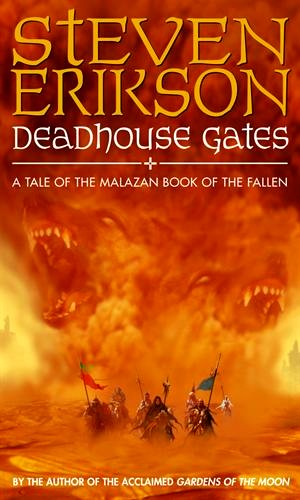
The second novel in the Malazan Book of the Fallen series makes a sharp turn away from the story of the Empire's invasion in Genabackis. The reason - believe it or not - is that Memories of Ice's draft got lost in a computer crash and Erikson was so frustrated, that he wrote an entirely new book before returning to his original storyline. Whatever the reasons, the model of jumping to different storylines between books turned out to be successful, so there's no reason to complain.
Deadhouse Gates is situated in the desert continent of Seven Cities. The birthplace of humanity, and home to the First Empire of man, it was also the first to fall under the expanding Malazan Empire's rule. But now a rebellion rises - the Whirlwind, led by the prophetess Sha'ik who resides in the holy desert of Raraku. As the occupied territories fall one by one, the Seventh Army, under the command of the legendary Malazan Fist Coltaine, begins a daring journey across the continent to get fifty thousand refugees to the safety of the Imperial Seven Cities capital of Aren - a march that will later be known as the Chain of Dogs. Amidst the chaos of the Whirlwind, the ancient and powerful half-Jaghut Icarium travels on the Path of Hands to find clues to a past he does not remember.
Meanwhile the Empire's nobility is being culled by the Empress to prevent the noble families from gaining too much power. Many are killed, but others, like the young Felisin Paran - sister to the Bridgeburners' commander Ganoes and the Empress' Adjunct Tavore - are sent to the mines of Otataral island, to dig for the sorcery-negating substance. The cull sends Felisin on a journey that would change the course of events on the opposite side of the world.
Deadhouse Gates is arguably the best book in the series so far (and considering the significant decline in quality in later installments that is not likely to change). The three intertwining stories of the Chain of Dogs, Icarium's journey and Felisin's adventures create an epic tapestry rich with the ancient history hidden under the sands of Seven Cities, and revelations concerning both the Empire's origins and the bigger powers that play a part in the apocalyptic events of the rebellion. It also marks an amazing improvement in terms of style. Erikson's prose - at times clumsy and clunky in Gardens of the Moon - suddenly blooms into a rich and mature writing that will hold for the next four books, before starting to degenerate into the verbose heaviness of the last few installments.
10/10

While Deadhouse Gates is possibly the most stand-alone part in the series, it is still only a step in the development of the myriad story-lines that are meant to converge at the ending of the series. Thus comes House of Chains, book 4 of the Malazan Book of the Fallen. After the events of the Whirlwind and the Chain of Dogs, the Empire sends Adjunct Tavore Paran and the Fourteenth Army to venture into the heart of Holy Raraku and confront Sha'ik herself.
Meanwhile, from the northern mountains on the continent of Genabackis, a man like no other arrives into the world. Karsa Orlong is Teblor - a race of giants, descended from the legendary ancient Toblakai. He sets on a journey that will change not only his life, but the fate of the entire world.
House of Chains develops both the Seven Cities stories and that of the Crippled God's ascension, after he was introduced in Memories of Ice. Although a lot of important events occur, it is less self-contained than the previous two novels. Erikson's introduction of Karsa is also controversial, because for the first time a single-character story-line takes a quarter of the book without ever switching to a different character.
It is still a solid book though, and closes nicely the Whirlwind line, even if a few loose ends are left for book 6, The Bonehunters. It also introduces the series' most notorious character, and sets the scene for the third and final big story-line of the Malazan Book of the Fallen.
8.5/10
Next: Malazan: The early books - Lether
Jul 22, 2010
The Malazan Book of the Fallen is oficially done!

Via Facebook:
GASP! That would be me, coming up for air. How long was I down there? About twenty years, from conception to completion. The Malazan Book of the Fallen is done. Sure, editing and all that crap to follow. But ... done. I don't know who I am. Who am I again? What planet is this? Three months of butterflies ... maybe this double whiskey will fix that. Hmm. No. Delayed reaction going on here.
Congratulations to Steve! It's a major achievement finishing a series of such magnitude in such a short time. SOME authors should take note...
The Crippled God is expected on 20 Jan 2011 in the UK, and on 22 Feb 2011 in Canada (and possibly the US).
Jul 17, 2010
Malazan: The early books - Genabackis

After describing the Malazan world, it is time to go into the novels themselves. However, the story of the Malazan Book of the Fallen is way too complicated to go book by book. In the first five installments of the series three major plot-lines are presented, on three separate continents. Characters sometimes jump from one to the other, but mostly they are almost completely self-contained until book six, The Bonehunters, where they start to merge. So, I have decided to separate my first posts on the series into plot-lines instead of books. This entry covers the continent of Genabackis, where the first and third novels are set.
Gardens of the Moon begins with the siege of the city of Pale in northern Genabackis - another step in the conquering campaign of the Malazan Empire. As Pale falls, seemingly abandoned by its allies - the Tiste Andii of Moon's Spawn - Empress Laseen sets her gaze on Darujhistan - the jewel of the continent, and its richest city. The few surviving Bridgeburners - an elite group of soldiers, lead by the legendary Sergeant Whiskeyjack - are sent before the army, to ensure victory from within. But many powers gather to prevent Laseen's insatiable conquest. Anomander Rake, the Son of Darkness, allies himself with Darujhistan, while the Ascendants of High House Shadow - the gods Shadowthrone and his right hand Cotillion - have their own reasons of wanting to hurt the Malazan Empire. Meanwhile Oponn - the twin-gods of Chance - play a game in which two mortals become their unwitting pawns. And as powerful forces converge on Darujhistan, and a few mundane humans try to stay alive amidst the onslaught, an ancient creature stirs in the outskirts of the city - one mighty enough to shatter all carefully arranged plans in its icy fist.
The beginning of the Malazan Book of the Fallen has a few faults that prevent it from appealing to the broad audience. One of those is the fact that Erikson chooses to literally thrust you into the middle of a raging battle. As the reader finds himself among the soldiers of the siege of Pale, he is drowned under a wave of names, relationships and history that he knows nothing about. True, it takes less than fifty pages to find your way to the surface of those dark waters, but it is an unfriendly beginning to say the least, and many people don't like being treated in that way. Then follow the "GotMisms", so named because they are incongruities specific to the first book - things that contradict facts, established in further installments. Nothing particularly major though, and definitely nothing that steals from the enjoyment of the book. Steven Erikson's style is still a bit tentative here, not daring (or simply not yet matured enough) to unleash his full potential. Still, the quality of his writing is high, even if some parts are chunkier than others.
In the end, Gardens of the Moon is not even half as good as the books that follow it, but still remains among the best in the genre, and sets the scene for most of the major plot-lines that comprise the series. I would strongly recommend giving it a chance, and if after it you are unsure as to where you stand with Steven Erikson - plunging directly into Deadhouse Gates. By its end you will know.
7/10

Book three, Memories of Ice, continues the story of those left on Genabackis. After the disastrous events of Gardens of the Moon, the survivors have forged new alliances, as an unexpected threat has risen in the southern part of the continent - the Pannion Domin and its mysterious leader, the Pannion Seer. The Domin conquers and literally devours every land on its way north, and the fragile alliance of powers forged to stop it is nowhere nearly enough to defeat it. Until the undead hordes of the T'lann Imass emerge to join the battle, following a new call to arms and the tiniest glimmer of something that has long been buried under the ash of millenia - hope.
Meanwhile, in the city of Capustan, the mercenary army of the Gray Swords must defend against the cannibalistic tide of the Domin, while hoping against hope that help will come from outside. And underneath it all, something poisons the Warrens themselves, turning traveling through them, and even the simple use of magic into a deadly perilous affair. Bridgeburner mage Quick Ben is bent on unraveling this mystery, before magic becomes completely unaccessible.
Memories of Ice finally gives us the main "villain" of the series, if he could be called such. The Crippled God, fallen from the skies after being summoned from a place outside of the Malazan plane and its Warrens, has been chained by a host of Ascendants, but he still manages to touch the world both directly, and through those he bends to his purposes. And his power is growing...
The third installment in the Malazan Book of the Fallen was for a long time my favorite. After rereading it, I realized that its main appeal is in the thunderous revelations and plot-twists it contains, and thus the experience diminishes after the first time. Still, Memories of Ice is undoubtedly one of the best books in the series, especially due to the fact that it is centered mostly around the T'lan Imass and their tragic fate. Also, together with book two, it boasts the most epic, emotionally engaging and truly "heroic" ending in the series so far. The intensity of emotion is so huge, that I can't read its last fifty pages without putting the book down for short rests. Erikson's style, after its sudden bloom in book two, Deadhouse Gates, is in top shape here, finding perfect balance between exuberance and narrative flow (one which the author will, regrettably, lose in later installments). The novel is a fast read, despite its scope and the rich descriptive prose used to paint its chaotic world.
In the end, Memories of Ice is Steven Erikson at his very best, proving that the Malazan Book of the Fallen is a bar setter and a series to be reckoned with. The book is among the very few greatest examples of what Fantasy is capable of, and an unquestionable must read.
9/10
Next: Malazan: The early books - Seven Cities
Jul 14, 2010
Malazan: An Introduction, Part II

...continued from Malazan: An Introduction, Part I
While the conflicts of the four Founding races teared the world, a different war raged in Kurald Galain, the Elder Warren of Darkness. Mother Dark, creator of the multiverse, had committed a sin in the eyes of her children - the Tiste Andii - by giving birth to Light. Anomander Rake, her second son, led a small group of his race into the Malazan world, swearing never to return to the mother that turned her face away from her firstborn. Others followed him later, together with their new cousins - the Tiste Edur, Children of Shadow, born from the congress of Light and Darkness. The Andii and Edur fought a war with the already declining K'chain Che'Malle and won, but a betrayal from within led to the near decimation of the children of Darkness. In the end, Anomander Rake's followers were among the few who survived, while the Edur left for a distant land. The Son of Darkness now dwells in a flying mountain called Moon's Spawn, pledging the help of his people to causes not their own, as even though they can use the powers of Kurald Galain, entry to their home Warren is forever denied to them.
Powerful beings walk the Malazan world. Some of them manage to obtain godlike powers and immortality. The paths to Ascension are many, and the Ascendents assume different roles. Some, like Anomander Rake, lead their people, denying their attempts to revere them. Others grasp at godhood, gathering followers or slaves and feeding off their faith. But just as not all Ascendants are gods, the opposite is also true, for there are gods that were never mortal. Some were part of the forces that shaped the multiverse, while others were called into being by the myriad beliefs of civilizations sometimes long gone.
Many other powers form the balance of the world, such as the shapeshifting Soletaken and D'ivers; the sentient Houses of Azath that sprout at random places to imprison in their grasp everything that threatens the order of the multiverse; the draconean Eleint, children of the dragon goddess Tiam and Starvald Demelain, the First Warren; and a plethora of other creatures, races and groups that wage war on each other, form alliances and play in the games of intrigue that span worlds and centuries.
***
It is easy to lose oneself in the labyrinth of the Malazan world, with its myriad factions, ridiculously overpowered characters and ceaseless conflicts. What I've spent two posts in describing is never presented in such a synthesized form. Steven Erikson never explains anything outright, and sometimes different points of view present conflicting information. And yet, it is all there, and it quickly starts to make sense. Even when you feel you've been thrust in the middle of an unfamiliar place with its unfamiliar history and a vast cast of characters you know nothing about at the beginning of Gardens of the Moon, the story just propels you forward, until suddenly you realize this grasping for firm knowledge is unnecessary. Because, especially in the first half of the Malazan Book of the Fallen, you become part of this world. And as such, you can't ever truly know the whole picture - not until you've lived through it.
Next: Malazan: The early books - Genabackis
Jul 13, 2010
Malazan: An Introduction, Part I
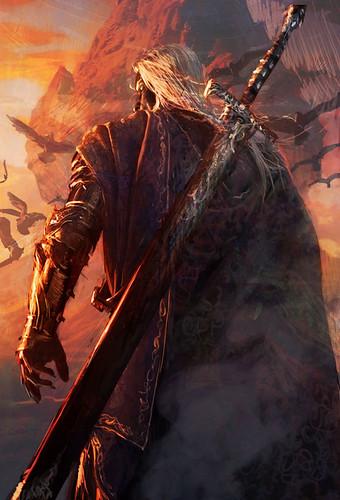
I was first introduced to the Malazan Book of the Fallen around the time that book five, Midnight Tides, was coming out. By that time my fantasy experience had been pretty standard, with names like Jordan, Martin and Feist comprising the core of my knowledge of the genre. Then along came Steven Erikson and knocked me off my feet, changing my whole perspective of the field. Here was a series of such epic proportions, a vast world of such immense historical depth, and a cast of characters of such magnitude and diversity, that I could not believe a single person could have invented it. I was later to learn that it were actually two people that invented it, but at the time Esslemont's name was still unknown.
I fell in love with the series, and it bordered on religious adoration until book six, The Bonehunters arrived. Even then I retained most of my good feelings for the Malazan world, but then came books seven and eight, and the magic was mostly gone. But the journey is not over (and neither will it be over when the final tenth installment of Book of the Fallen comes out, since there are many more tales in this universe), and I am yet to read book nine too. But although my feelings for the series are somewhat colder now, I still consider the first five books to be among the greatest examples of what Fantasy has to offer. There has never been another work in the genre that deals with events of such magnitude, on such a broad scale and with so many fully developed characters.
So I decided to write a series of posts on the topic. Not exactly reviews, although the latter ones may turn out to be such, but more an overview of the Malazan world. I am not entirely sure how many posts there will be, although I am guessing the number will be around five or six. There will be no spoilers, although some of the stuff written bellow might be more fun to dig out on your own. Still, I'd like to think that it is safe to read my ramblings without fear that they would ruin your enjoyment of the books if you haven't read them yet.
And here we go.
The Malazan world is a place of ancient secrets and devastating cataclysms. Powerful godlike beings dwell on its many continents among races both old and young, human and inhuman. It is a world of layers, where what has happened before never disappears, but sleeps under the feet of civilizations rising and falling for hundreds of thousands of year, waiting to be awakened. It is the center of a multiverse created by Mother Dark, one through which the blood of an Elder God flows freely to create the streams of magic.
As the story begins, we are introduced to the powerful Malazan Empire. A century ago a band of rogues captured a small pirate island off the coast of the continent of Quon Tali. Led by the charismatic Kellanved, those extraordinary people created the heart of what was to be a power to conquer half the known world within less then three generations. At the time of the first book, the Empire controls three continents and wages wars of conquest on two others. Its armies are the finest fighting force in the world, as the brilliant Malazan leaders have paid heed to the lessons of innumerable civilizations that have preceded them. But the Empire is only the beginning for its creators.
Outside, inside, over and under this world are the Warrens - pocket dimensions, through which mages can both travel and access their magic. Some of the Warrens are aligned to an element or a god. Others are the birth places of the world's races. Many are not accessible to humans. They are both places and the road to places. Sources to power and knowledge. And some of them have preceded the Malazan world itself. Magic is always fluid in the Malazan series. There is the ordered system of the Warrens. But there is also the magic of ancient spirits and shamanism. There is the power of faith and symbolism, and there is the power of curses that span millenia. And those often merge to create mind-blowing effects, especially in the first few books.
The Malazan world is populated by many sentient races, and all of them are original creation of Erikson and Esslemont. No elves and dwarves here. First, the Four Founding races:
The ancient prehistoric progenitor of humanity, the Imass, made the ultimate sacrifice to wage a war of utter extinction on beings who had the power to trap whole continents in a prison of ice. They became the undead T'lan Imass - immortal and indestructible creatures of dust and fire who can not find rest as long a single one of their enemies still breaths. But the mortal was never meant to endure the weight of immortality, and as hundreds of thousands of years pass, the T'lan Imass' souls have turned to dust, and of memories of ice.
The Jaghut were once the rulers of the world, after the decline of the K'chain Che'Malle. Creatures of Omtose Phellack, the Elder Warren of Ice, they were forced to live alone by their own power, as the conflicts between Jaghut could tear down continents. As they themselves had once been slaves, so too did they enslave the hapless Imass, posing as gods for no other reason but the joy of control. Too late the Jaghut realized the threat that loomed beyond the horizon, and even as the last Jaghut Tyrant was cast down by his own kind, the immortal T'lan Imass emerged to drive their race to near extinction. Three hundred thousand years later the immortal Jaghut still pay for their hubris.
Little is know of the lizard-like K'chain Che'Malle, except for the fact that they came from beyond the stars, and used technologies that the world has not yet rediscovered. Their Matrons possessed powerful magic and utter control over their broods. Until a new experimental breed turned too volatile to control, and the ensuing civil war destroyed the K'chain Che'Malle civilization, opening the way for the emergent Jaghut.
Even less is known of the mysterious Forkrul Assail. They were creatures of limitless power, almost indestructible, with tremendous physical strength and near impervious to magic. The Assail never formed any sort of culture, nor did they have connections to the other races of the world. Obsessed with balance, their only interaction with others was to come when imbalance was perceived, to unleash a genocide of apocalyptic proportions and then vanish again. At the time the series takes place they have disappeared, although some remain in remote places.
To be continued...
Next: Malazan: An Introduction, Part II
Subscribe to:
Posts (Atom)