Showing posts with label Daniel Abraham. Show all posts

Oct 2, 2011

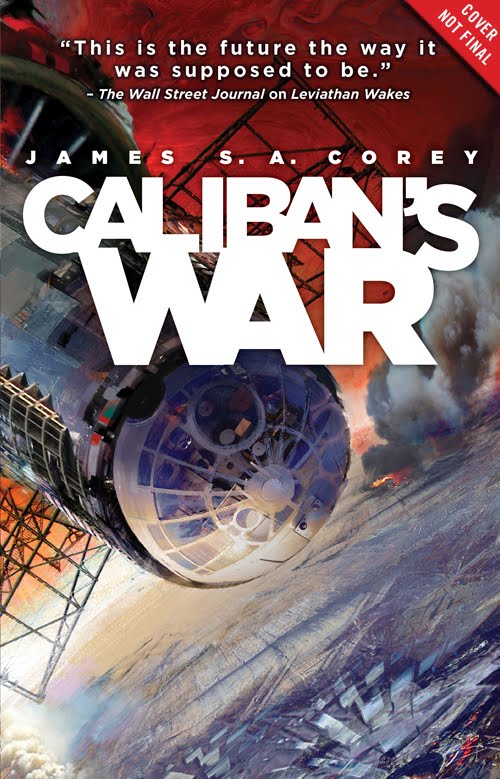
Artwork and sinopses for two Daniel Abraham books

Via A Dribble of Ink


War casts its shadow over the lands that the dragons once ruled. Only the courage of a young woman with the mind of a gambler and loyalty to no one stands between hope and universal darkness.

The high and powerful will fall, the despised and broken shall rise up, and everything will be remade. And quietly, almost beneath the notice of anyone, an old, broken-hearted warrior and an apostate priest will begin a terrible journey with an impossible goal: destroy a Goddess before she eats the world.


We are not alone.

The alien protomolecule is clear evidence of an intelligence beyond human reckoning. No one knows what exactly is being built on Venus, but whatever it is, it is vast, powerful, and terrifying.

When a creature of unknown origin and seemingly impossible physiology attacks soldiers on Ganymede, the fragile balance of power in the Solar System shatters. Now, the race is on to discover if the protomolecule has escaped Venus, or if someone is building an army of super-soldiers.

Jim Holden is the center of it all. In spite of everything, he’s still the best man for the job to find out what happened on Ganymede. Either way, the protomolecule is loose and Holden must find a way to stop it before war engulfs the entire system.

CALIBAN’S WAR is an action-packed space adventure following in the footsteps of the critically acclaimed Leviathan Wakes.


The second Dagger and Coin novel and Leviathan Wakes' sequel. Both covers are not finalized, but I think they both look awesome! Haven't read the first part of either series though, so can't get excited yet.

Sep 28, 2011

A Game of Thrones comic book series, Issue 1


The first issue of the comic book adaptation of George Martin's A Game of Thrones is now out. The mini-series will come out on a monthly basis, and be followed by a new title for every separate book.

Personally, I wasn't impressed. The words are good - Daniel Abraham's done a great adaptation, using exactly the necessary amount of description and dialogue, with only a few instances of added information, when the dialogue would not be enough to present the information that the reader would otherwise read in the novel.


Problem is, I've already read the novel - and more than once - so the only thing the adaptation can offer me are the visuals. And they are... bland. I have never been impressed with Tommy Patterson's art, and it is nothing to write home about here either. The pouty overly pretty and wavy-haired characters would be much more in place in a teenage girl comic book, and the color scheme - done by Ivan Nunes - is entirely too bright. The comic book is definitely not ugly, but it is also nowhere near the style that I think would suit Martin's gritty world best.

And, sadly, the story shows early signs of PG13-ness. Even though the first issue goes only as far as Daenerys' first meeting with Khal Drogo, there is at least one instance of nudity and borderline sexual cruelty that has been cut. And honestly, A Game of Thrones without the realism, sex, violence and dark visuals doesn't seem like much fun now, does it?

Still, I'll follow the series. Who knows, it might grow on me...

6/10

Feb 2, 2011

A Song of Ice and Fire comic book adaptation

George R. R. Martin announced on his not-a-blog that Bantam has acquired the rights and together with Dynamite Entertainment is going to publish a series of monthly issues. The comics will be scripted by Daniel Abraham and drawn by Tommy Patterson. The first issue is scheduled to be released in late Spring 2011. Until then, here are two concept arts from the artist - of Jon Snow and Tyrion Lannister:


Jan 1, 2011

2010 In Retrospect

I read a staggeringly small amount of books this year (you will notice that only two of my choices were actually published in 2010), due to life coming out of nowhere to intervene with my quiet geekiness. Also, this is the first time I've ever actually had to do this kind of thing, so I decided to keep it modest. If - Xenu willing - I'm here next year, I'll probably put more thought into the task.

So, here's

Roland's Random Lists of 2010:

Best books of 2010:


1. The Windup Girl by Paolo Bacigalupi (Review)
There is absolutely no competition for my first place this year. Bacigalupi's environmental dystopia is easily one of the best books I've ever read, and I am happy it got all the acclaim it deserved. I am expecting great things from Bacigalupi, and can't wait to read his novella The Alchemist, if only to see what he would do when unleashed on the Fantasy field.


2. Dragonfly Falling by Adrian Tchaikovsky (Review)
After the first slightly uncertain steps Tchaikovsky made in his debut novel Empire in Black and Gold (review here), the second book in his Shadows of the Apt series showed how grand his world really is, and how much more complex it will get in future novels. The totemic relationship between kindens and their insect avatars, as well as the steampunk elements make for one of the most original epic fantasy worlds in a long time. The fact that Tchaikovsky seems to be getting better with each new novel doesn't really hurt either.


3. Little Brother by Cory Doctorow (Review)
I honestly didn't know what to expect from Doctorow's dystopic YA tale when I started reading it. I am allergic to books that are too "savvy" when it comes to the techno-slang and online culture, but in this case the balance between that and actually good story-telling turned out to be so good that I instantly fell in love with the book.


4. Leviathan Wept and Other Stories by Daniel Abraham (Review)
Although slightly underwhelming - after the hype I'd been exposed to - Daniel Abraham's short story collection was among the events of 2010, and definitely shows an amazing storytelling potential. A name to pay attention to, without a shadow of doubt.


5. The Hero of Ages by Brandon Sanderson (Review)
Although not the best of the series (that honor falls to Mistborn (review here, and here for The Well of Ascension)), The Hero of Ages was a great and mind-bogglingly epic conclusion to one of the best fantasy trilogies written in a long time. Sanderson's detractors keep pointing out his "shyness" when it comes to the topic of relationships and sex, as well as his two-dimensional characters, but in truth, the Mistborn series was almost a text-book example of how to do high fantasy without being numbingly cliche about it. And of course there is the gloriously good magic system(s) that seems to be Sanderson's trademark.


Author of 2010:


Brandon Sanderson
He may not be the brightest literary star in the fantasy genre (it's hard with competition such as George Martin, Gene Wolfe, Scott Bakker or Steven Erikson), but regardless of whether you're a fan or not, Sanderson's success can't be denied. 2010 saw the publication of three of his novels, and the guy doesn't seem to ease up or slip in terms of quality. To be as prolific and consistent is no small feat, and I believe it deserves recognition. As well as the fact that - my respects to both the late Robert Jordan and his most dedicated fans - he is single-handedly saving The Wheel of Time from an underwhelming and disappointing ending while writing with a speed three times that of its creator. So how was your 2010?


Biggest disappointment of 2010:


The Dervish House by Ian McDonald (Review)
Yes, I know this book is on the top places in most other people's "best of" lists, and of course I'm not putting it in this category because I think it's bad. It just didn't connect with me in any conceivable way, and I felt it was completely unequal to the praise it got. And although Ian McDonald is obviously an amazingly talented writer, both this book and the 3/4 of Desolation Road that I read make me think that he just doesn't have the spark that makes the reader actually want to go on reading his work. Or at least he definitely doesn't have the spark that makes me want to...


Discovery of 2010:


Paolo Bacigalupi
There was a pretty big list of names to chose from, considering most of the writers I read this year I had no previous experience with. But Bacigalupi is easily the most promising of all of them, and I can't wait to read his next mature novel. Of course, my mild dislike of environmental themes might ultimately ruin the relationship, but so far it's all going so well...


Most underwhelming new voice of 2010:


Jon Sprunk
I feel slightly penisy for doing that, especially considering that Sprunk's Shadow's Son (review here) wasn't half-bad. Thing is, it was way, way, WAY too predictable and "by the numbers". I'd read it before. Many times. And in some cases more interestingly written. I guess that's the curse of the time we live in - you can only use the classical tropes if you are really amazing with them (Patrick Rothfuss), or if you introduce new elements (Adrian Tchaikovsky). And since Jon Sprunk did neither of those things, Shadow's Son read like something... tired. You don't want that from a debut novel. I am having my fingers crossed for the second part in the series to do better; I think Sprunk has the potential for that.


The books I'm most sorry I didn't get around to:

This is just a list of the titles I really wanted to check out, but couldn't read this year. There's no particular order to it.

Kraken by China Mieville
Surface Detail by Iain M. Banks
The Way of Kings by Brandon Sanderson
The Gathering Storm and Towers of Midnight by Brandon Sanderson and Robert Jordan
The Sorcerer's House by Gene Wolfe
Dust of Dreams by Steven Erikson
The Long Price Quartet by Daniel Abraham
The First Law Trilogy by Joe Abercrombie
The Living Dead and The Living Dead 2 anthologies by John Joseph Adams
Ship Breaker by Paolo Bacigalupi
Anything by Glen Cook, Michael Moorcock, Alastair Reynolds, Paul Kearney, K.J. Parker and Richard Morgan


Well, that's all folks. 2011 promises to be utterly amazing on the SFF front, and I hope I have more time to dedicate to that, as the amount of forthcoming books I HAVE TO read is slightly scary. But anyway, Happy New Year to everyone, and I hope you didn't make any NY resolutions, as those are lame, but I also hope the year turns out to be all you're hoping it to be!

Nov 3, 2010

More Daniel Abraham goodness


Orbit has revealed the cover art of Leviathan Wakes - space opera, co-written by Daniel Abraham and Ty Franck under the pen-name S. A. Corey due to be published in May 2011. The cover is all kinds of awesome, as you can see. There is a post on Orbit's blog about it, as well as a wallpaper page, if you're into that kind of thing.

Oct 10, 2010

Leviathan Wept and Other Stories - Daniel Abraham


I first heard Abraham's name when Hunter's Run - his collaboration with George Martin and Gardner Dozois - came out. Since then he has been a constant presence in the blogosphere, and always mentioned with great admiration. So I decided to try his short fiction first, before jumping to The Long Price Quartet.

Leviathan Wept and Other Stories is a very diverse collection. There is fantasy there, as well as post-cyberpunk, ghost stories, horror and just plain old comedy. The Speculative element is all but missing at times, but that steals nothing from the quality of the writing. And the quality of writing is very, very high. Abraham delves into disturbing topics with energy and determination, and doesn't shy away from uncomfortable truths. His style of writing is rich enough to allow the diversity of genres and themes, and the ideas around which the stories evolve, are - more often than not - rather original.

The Cambist and Lord Iron is a Victorian tale of a noble playing a bad joke on a money-changer, only to find himself in need of his services again and again, when he has to determine the value of more and more abstract concepts. There is no obvious supernatural element to the story, apart from some hints of the world being an alternative reality, but the focus of the tale itself is somehow outlandish enough to make it feel like fantasy.

Flat Diane is a story of subtle horror and implied brutality, in which a father cuts his daughter's image from paper and sends it across the world to reconnect with distant relatives. Too late he realizes that he has sent away a part of his little girl's soul. And as she grows up, she is forever changed by the experiences "Flat Diane" has. This is perhaps the most horrific story in Leviathan Wept, and the fact that nothing actually happens for the reader to "see", that it is all "off-screen" and implied, makes it even more so.

The Best Monkey is the other story in the collection bordering on horror, or at least that's how it felt to me, since altered humanity always chills me. In this particular case, the plot revolves around the perception of beauty, and what happens when that perception is changed.

The Support Technician Tango is perhaps my favorite in Leviathan Wept - a comedy about a malicious self-help book that wrecks havoc in the lives of all the employees of a law firm. It is witty, elegant and smart, and flows with such ease, that it's pure delight to read.

Then comes A Hunter In Arin-Qin, a fantasy story that shares absolutely nothing with the previous four. Its protagonist is a mother tracking the demon who kidnapped her daughter. There is something of Gene Wolfe in this tale of unlikely revenge, both in structure, and in the atmosphere of mystery, of things left unsaid.

The titular story, Leiathan Wept, was a bit of a disappointment to me. It deals with analogies in a world where connections between people have maybe turned humanity into bigger organisms in which individual humans are only cells. And those organisms might be at war with each other. But what if there is only one, and it is just sick? Even though the idea is very interesting, and the story is well written, I found the development unsatisfying. The concept was intriguing, but remained vague, undeveloped, as if Abraham wasn't entirely sure what he wanted to do with it.

Exclusion is the story with the most interesting idea in the collection. It deals with a future society where technology has advanced to the stage where humans have their own AI systems integrated into their bodies, and those systems allow them to "exclude" other people from their existence. The Ignore function in a very extreme and literal sense, because contact with the excluded is impossible. You don't see them, they don't see you. You can't perceive them in any way, and neither can they perceive you. But what happens to a person's will and courage, when they can simply erase any problem with a thought? Unfortunately, the obvious happens - people prefer to run away from, and "ignore" the problematic relationships, instead of dealing with them. The story had great premise, and I sort of expected more than this simple moral from it.

As Sweet is another Wolfean tale - a poetic piece musing on the nature of love and passion, mixing different centuries but always getting back to Romeo and Juliet's (and more importantly - Rosaline's) Verona and the contemporary life of a literature teacher entering her middle years.

The Curandero and the Swede is a story about the importance of stories, and the way their meaning can change, and by changing - change us. It is the third tale reminiscent of Gene Wolfe's writing, and it deals with dusty roads, and Indian spirits, and Mexican witch-doctors, and all the right stuff that stories should be made of.

All in all, Leviathan Wept and Other Stories is a great collection. There are overarching themes in all stories, like that of sexuality. It is always there, sometimes obvious, others - just implied, but ever present. Many of the stories deal with IT and its evolution, and there is always some dry wit, no matter the seriousness of the plot.

Two things disappointed me a little. The first was the repetition of structure. Too many of the stories are structured in short passages that switch between some present and the slowly developing past that led to it. True, it is a tried and proven frame for a short story, but when you read it so many times in a collection by the same author, it becomes tiring. The second thing is that many of the stories revolve around a single idea, and when that is exhausted, they don't seem to have much to say. Examples of this are Leviathan Wept, Exclusion, and to a lesser extent The Cambist and Lord Iron, although the trend is recognizable in other places as well.

Still, it couldn't have escaped your notice that in three instances I actually compared Daniel Abraham to Gene Wolfe. People who know me should be aware that there is no higher praise I could give an author, and Abraham more than deserves this praise. He has a rich and diverse style of writing, great ideas, and that indefinable energy that compels the reader to continue reading, no matter what. Leviathan Wept is a brilliant book, and I hope we see more collections of his short works soon. Meanwhile, I will soon be jumping into his longer ones.

8/10

Cover art for Daniel Abraham's The Dragon's Path


This is not the finalized cover, supposedly. It is rather K.J. Parkerish, but I kinda like it. I have a lot of Abraham catching up to do before I get to this book though.

Oct 3, 2010

Synopses for two upcoming Daniel Abraham tiitles

I've been reading Leviathan Wept and Other Stories these past few days, and it's getting me pretty hyped for Daniel Abraham's work. Apart from moving his Long Price Quartet higher on my to-read list, I've been tracking him for snippets of his forthcoming novels. And thanks to A Dribble of Ink, here are the synopses for two of them:

The Dragon's Path:

Summer is the season of war in the Free Cities.

Marcus wants to get out before the fighting starts. His hero days are behind him and simple caravan duty is better than getting pressed into service by the local gentry. Even a small war can get you killed. But a captain needs men to lead — and his have been summarily arrested and recruited for their swords.

Cithrin has a job to do — move the wealth of a nation across a war zone. An orphan raised by the bank, she is their last hope of keeping the bank’s wealth out of the hands of the invaders. But she’s just a girl and knows little of caravans, war, and danger. She knows money and she knows secrets, but will that be enough to save her in the coming months?

Geder, the only son of a noble house is more interested in philosophy than swordplay. He is a poor excuse for a soldier and little more than a pawn in these games of war. But not even he knows what he will become of the fires of battle. Hero or villain? Small men have achieved greater things and Geder is no small man.

Falling pebbles can start a landslide. What should have been a small summer spat between gentlemen is spiraling out of control. Dark forces are at work, fanning the flames that will sweep the entire region onto The Dragon’s Path — the path of war.


and Leviathan Wakes by "James S.A. Corey" (Daniel Abraham and Ty Franck):

Welcome to the future. Humanity has colonized the solar system – Mars, the Moon, the Asteroid Belt and beyond – but the stars are still out of our reach.

Jim Holden is XO of an ice miner making runs from the rings of Saturn to the mining stations of the Belt. When he and his crew stumble upon a derelict ship, The Scopuli, they find themselves in possession of a secret they never wanted. A secret that someone is willing to kill for – and kill on a scale unfathomable to Jim and his crew. War is brewing in the system unless he can find out who left the ship and why.

Detective Miller is looking for a girl. One girl in a system of billions, but her parents have money and money talks. When the trail leads him to The Scopuli and rebel sympathizer, Holden, he realizes that this girl may be the key to everything.

Holden and Miller must thread the needle between the Earth government, the Outer Planet revolutionaries, and secretive corporations – and the odds are against them. But out in the Belt, the rules are different, and one small ship can change the fate of the universe.